
Montenegro: a fjord, Venetian walls and the Durmitor peaks
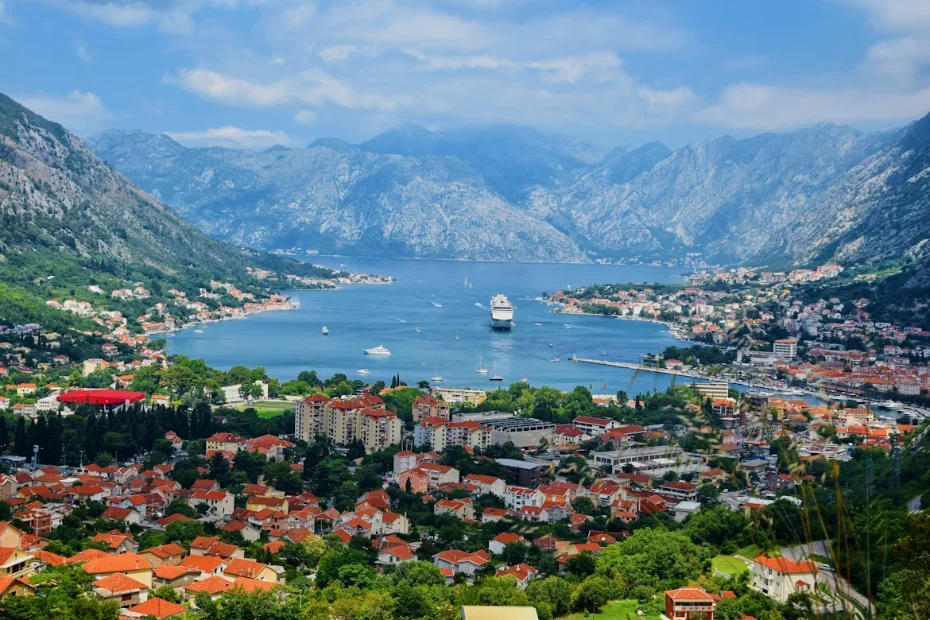
The bus came around one last headland and the Bay of Kotor opened up below me, and I genuinely thought for a second I'd taken a wrong turn into Norway. Steep grey-green mountains plunge straight into a sheet of still water, the road clinging to the shore as it threads past stone villages and church bells, and the whole thing folds back on itself like a fjord — except it isn't one, it's a drowned river canyon the locals call Boka, and it's all the more startling for sitting at the bottom of the warm Adriatic. Montenegro is a small country, barely bigger than a couple of French departments, and somehow it crams a fjord, a Venetian riviera and a glacier-carved high plateau into the space of a long weekend.
I'd come for five days with a backpack and a vague loop in mind: the bay first, then south to the beaches, then a hard turn inland and up into the mountains. What I hadn't quite braced for was how fast the country changes character. You can be eating grilled fish by the sea at noon and standing beside a glacial lake in pine forest by dusk, and the only thing that stays constant is the feeling that this place is far too varied for its size.
Kotor and the bay that thinks it's a fjord
Kotor's old town is a tangle of marble lanes wedged between the water and a near-vertical cliff, a fortified UNESCO maze where you give up on the map within minutes and just let the alleys spit you out into squares you didn't know were there. The real reward is above it: the city walls climb the mountainside in a long zigzag to the fortress of San Giovanni, more than thirteen hundred steps of them, and I did the haul in the early morning before the heat and the cruise crowds. From the top the whole bay lay spread out in a silver Z, the red roofs tiny below, a single ferry drawing a slow white line across the water. I sat on a warm stone and didn't talk to anyone for a while.
« Montenegro pays in euros and bills you like a foreigner — the one place the bay didn't warn me about. »
Here's the catch I want to be straight about, because it ambushed a couple at my guesthouse: Montenegro uses the euro, but it is not in the EU or the EEA. It adopted the currency unilaterally and is only a candidate to join the bloc — which means the European « roam-like-at-home » that makes your plan work for free in Croatia or Italy generally does not apply here. Paying for a coffee in euros lulls you into thinking your phone is home too; it isn't. It's the exact same trap as Serbia or Switzerland, and the couple next door only noticed when the roaming warning landed mid-afternoon. I'd sorted an eSIM before I crossed the border, so while they switched to airplane mode and hunted café wifi, I had data running from the bay road.
Budva, Sveti Stefan and the riviera
South of the bay the coast loosens into the Budva riviera, and Budva itself is the loud, sun-baked counterweight to Kotor's hush: another little Venetian walled town, but ringed this time by beaches and bars and the kind of summer crowd that doesn't go to bed early. I wandered the ramparts at golden hour, then spent a slow afternoon doing very little on the sand. A short way down the road I pulled over for Sveti Stefan, the fortified islet stitched to the mainland by a thin causeway, its terracotta roofs stacked so perfectly it looks staged — it's a private resort now, so I admired it the way most people do, from the viewpoint on the road above, the pink stone glowing against the blue. Coverage along this whole stretch was excellent, fast and unbothered the entire length of the coast.
Up to the Durmitor, where the signal gets honest
Then I turned my back on the sea and drove inland, and Montenegro changed costume completely. The road climbed past Cetinje — the small, dignified old royal capital, all faded embassies and museums — and I made the detour to Ostrog, the white monastery pressed impossibly flat into a sheer cliff face, a pilgrimage site that seems to grow out of the rock itself. Higher still lies the Durmitor, a national park of bare limestone peaks above the pine line, and at its heart the Tara canyon, often called one of the deepest in Europe, a green river gorge slicing nearly a kilometre down through the mountains. I based myself in little Žabljak and walked the easy loop around the Black Lake, the water mirroring the peaks so cleanly it doubled them. Up here the network turned honest about the terrain: strong in town, then thinning to a single flickering bar on the high trails and in the deeper folds of the canyon. It always came back when the valley opened — I'd just learned to download the map before leaving Žabljak.
📶 Hugo's tip
Montenegro's trap is sneaky: it pays in euros but sits outside the EU/EEA, so your European « roam-like-at-home » plan usually won't cover it — expect out-of-bundle roaming charges, exactly as in Serbia or Switzerland, unless you arrive prepared. Install an eSIM before you cross the border and have it active by the time you reach the coast. Signal is strong and quick around Kotor and Budva, patchier up in the Durmitor mountains, so download an offline map for the Tara canyon, the Black Lake trails and Žabljak. Check your phone's compatibility in 30 seconds here and find your Montenegro plan on the destinations page (if your trip also runs through EU/EEA countries like Croatia, your usual European plan covers those — a regional EU/EEA plan works too).
What I take away
Montenegro gave me a fjord that isn't one, a fortress town I climbed at dawn, a riviera that doesn't sleep and a mountain plateau that humbles you into silence — all of it inside one tank of fuel and one long weekend. It's European to the bone and pays in euros, yet sits just outside the lines that make your data simple, a small bit of border arithmetic that costs five minutes before you go. Sort it once, then let the Boka do the thing it does to everyone, with both hands free to point at the view.
— Hugo, still hearing church bells off the bay and the wind on the Black Lake.