
Tunisia: from the Tunis medina to the gates of the Sahara
I came to Tunisia for a single afternoon of blue and white, and stayed for everything that came before and after it. The country is small enough to cross in a few days and dense enough to make those days feel like weeks. From the rooftop of my little hotel in Tunis I could see, all at once, the satellite dishes of a modern capital, the green-tiled minaret of an old mosque, and — far beyond the rooftops — the flat shimmer of the Mediterranean that has been carrying ships to this shore for nearly three thousand years.
My plan was a line drawn from the sea to the sand: the medina of Tunis first, then the ruins of Carthage on the water, the painted village of Sidi Bou Saïd, and finally a long road south toward the edge of the Sahara. A capital, some old stones, one impossibly blue village, and a taste of the desert. What I didn't fully plan for was how the signal would shape the trip — easy and dependable in Tunis and along the coast, then thinning out, honestly, the further south the road carried me toward the dunes.
The medina of Tunis, and the sea at Carthage
The medina doesn't hand you a map and wish you luck — it simply swallows you. I spent a whole morning lost on purpose in its souks, following the smell of cumin and roasting coffee, brushing past stalls of slippers and lanterns and folded carpets, until I came out, blinking, at the foot of the Zitouna mosque at the heart of it all. Tunis is a UNESCO-listed maze, and getting deliberately lost in it is the point. When I finally wanted to find my way back, my phone picked me up without complaint — in the capital the connection was genuinely fine, enough to drop a pin, message the guesthouse, and read up on which gate I'd accidentally wandered out of.
That afternoon I took the little suburban train out to Carthage, and the past changed register entirely. Here the ruins sit right on the Mediterranean: tumbled Punic foundations and, just along the shore, the Baths of Antoninus, a Roman bathhouse so vast that even its collapsed lower level makes you feel small. You stand among broken columns with the sea breathing a few metres away, and you try, and fail, to hold five thousand years in your head at once.
« I went looking for the bluest village in the world and found it perched above the sea, exactly as promised, with a mint tea waiting and a cat asleep in the sun. »
And then Sidi Bou Saïd, just up the coast — the village everyone shows you in photographs, and for once the photographs undersell it. White walls, blue doors and shutters, bougainvillea spilling over everything, all of it perched on a cliff above the water. I climbed to the Café des Nattes, sat on a woven mat with a glass of pine-nut tea, and let an hour go nowhere. I'll admit I posted one photo, because some things are meant to be shared, and along the coast the upload went through without a fuss.
El Jem, Kairouan, and the road south
From the coast I turned inland and south, and the country opened up. I stopped at El Jem, where a colossal Roman amphitheatre rises out of an ordinary town like something dropped from the sky — you can climb its tiers and stand where crowds once roared, the stone gold in the afternoon light. Further on lay Kairouan, one of Islam's holy cities, where the Great Mosque sits low and immense behind sand-coloured walls, its courtyard so wide and still that voices drop to whispers without anyone deciding to.
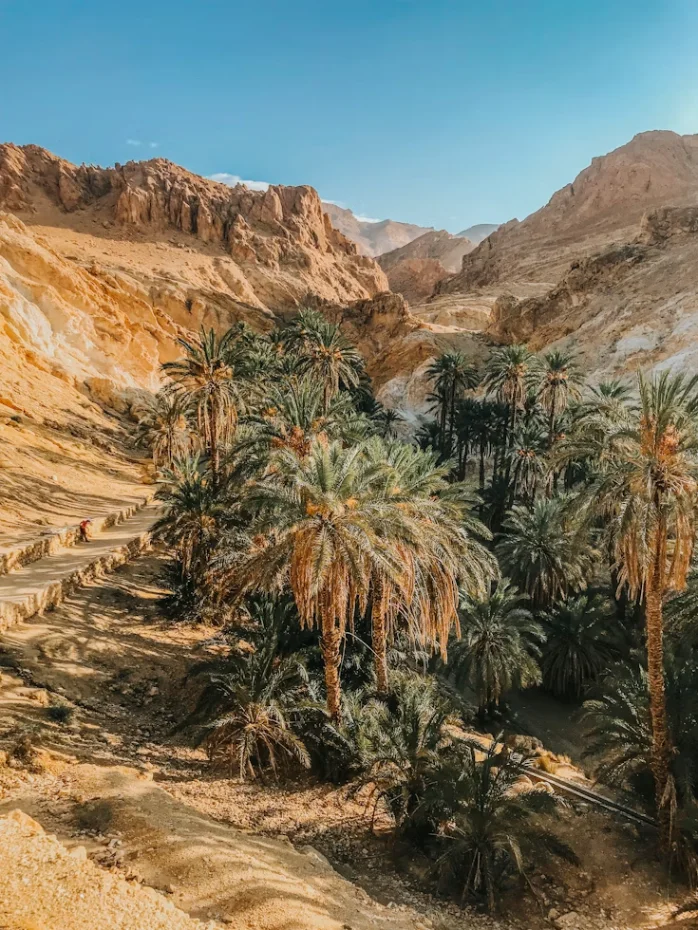
The road kept going south, toward Douz — the town they call the gateway to the Sahara — and the country grew quieter and drier with every hour. Somewhere out here the network began to thin: solid in the towns, patchy on the long stretches between them. Around Matmata, where families have carved their homes down into the earth in pits and tunnels (and where, if you grew up on a certain set of films, you'll recognise a desert homestead or two from a galaxy far, far away), I'd already learned to check my map before I lost the bars, not after.
A taste of the Sahara
At Douz the tarmac gives way to sand, and beyond it the dunes simply begin. I rode out a little way at the cooler end of the day, the camel rolling under me, the light going long and orange over an emptiness that doesn't end. And here the honesty has to come in: out toward the great salt flat of the Chott el-Jérid and the oases of Tozeur, coverage gets thin and then it leaves altogether. The desert doesn't care about bars on a screen. I'd downloaded an offline map and told my guesthouse my rough plan before the signal faded, which out here is just common sense. For one long hour I sat on warm sand watching the colour drain out of the sky, completely unreachable, and it was the part of the trip I think about most.
📶 Nora's tip
Tunisia sits outside the EU, so there's no roam-like-at-home here — set up a dedicated eSIM before you go. In Tunis, along the coast (Carthage, Sidi Bou Saïd) and in the towns, plan on usable data — enough to navigate the medina, book a guide, and confirm transfers. Heading into the deep south — Douz, the Chott, the Tozeur oases — assume the signal will thin or vanish: download an offline map and share your plan before you leave the last town. Check your phone's compatibility in 30 seconds here and find your Tunisia plan on the destinations page (if a separate European leg is on your itinerary, a regional EU/EEA plan covers you there too).
What I take away
Tunisia gave me the whole arc in a handful of days: the press and clamour of the Tunis souks, the sea breathing through the ruins of Carthage, one absurdly blue village above the water, and at the far end the clean silence of the Sahara. The signal traced the same line — there when I needed to find my way out of the medina or post a photo from a café, gone when the sand wanted me to put the phone down. I didn't fight that. I planned around it, and it made the connected hours useful and the disconnected one unforgettable.
— Nora, between a mint tea and a dune, watching the colour leave the sky.