
Rwanda: Kigali, the gorillas and the land of a thousand hills
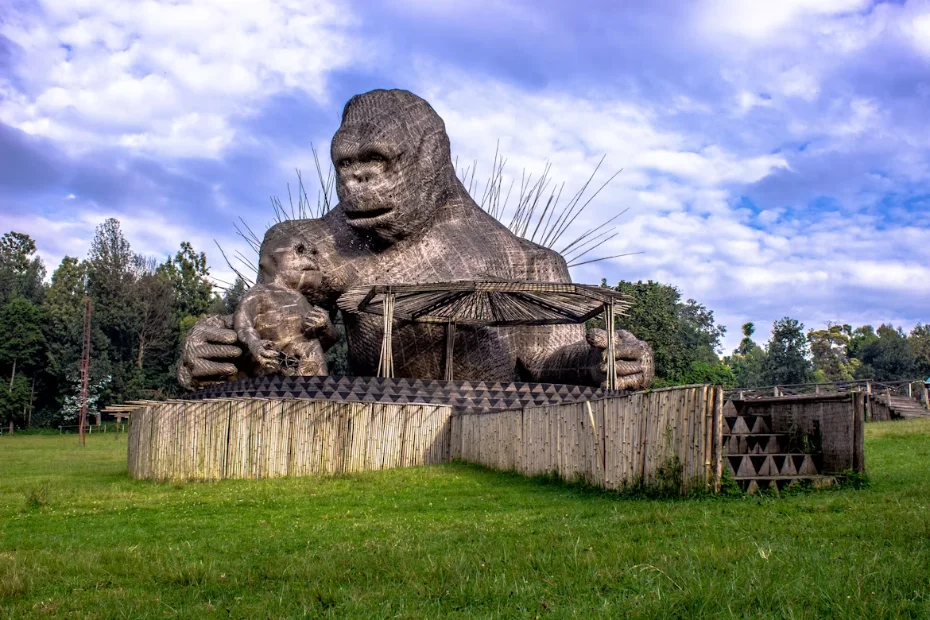
Some countries you arrive in. Rwanda you climb into. The plane banks over a green corrugation of hills that goes on past the edge of the window, ridge after ridge folding into the haze, and you understand the nickname before you've even landed: the land of a thousand hills. I came for the gorillas, the way most people do. I left thinking about the hills, the silence, and a single morning in a building I will not forget.
Kigali was my first surprise. I'd braced for the usual capital chaos and got something quieter, cleaner, almost disarmingly ordered. The streets are swept. There is no plastic-bag litter snagged in the gutters — the country banned them years ago, and it shows everywhere, in a way that slowly stops being remarkable and just becomes the texture of the place. Motorbike taxis hum up and down the ridges, traffic actually waits at lights, and the whole city seems built on the sides of hills, so that every street is also a viewpoint.
A morning at the memorial
I want to write about this carefully, because it deserves care. In 1994, Rwanda endured a genocide in which hundreds of thousands of people were murdered in roughly a hundred days. The Kigali Genocide Memorial sits on a hillside above the city, and beneath its gardens lie the remains of more than a quarter of a million victims. I spent a morning there. I am not going to describe the exhibits in detail — that is something you should meet on your own terms, in the quiet, without me narrating it for you. I will only say this: go. Go slowly, leave your phone in your pocket, and give the place the time and the silence it asks for. I came out into the sunlight changed, and grateful to a country that chooses to remember rather than look away.
« You come for the gorillas. You leave understanding why the hills feel so quiet. »
Outside the memorial, Kigali handed me back the ordinary world, and with it a steady signal. This was the honest surprise of the trip: Rwanda is unexpectedly well connected for the region. The country has invested heavily in fibre and 4G, and in the capital and along the main roads my phone simply worked — maps to find my guesthouse, a message home, the next leg booked from a café table. I'd half-prepared for a connectivity scavenger hunt and instead spent my city days online without thinking about it. That ease, I'd soon learn, has edges.
Up to the volcanoes
The gorillas live in the north, in Volcanoes National Park, on the flanks of the chain of dormant volcanoes that Rwanda shares with its neighbours. This is Dian Fossey's old ground — the forest where she spent years among the mountain gorillas, and where her research helped pull the species back from the edge. You feel that legacy in how the trek is run today: tightly, respectfully, with a permit that is expensive and must be booked well in advance. Like its neighbours, Rwanda keeps the numbers small on purpose. This is not a turn-up-and-go experience, and the planning is part of why the animals are still here.
The trek itself begins with a briefing and a climb. You walk up through farmland that gives way to dense green forest, guides ahead with the trackers' radio crackling, the altitude making itself politely known in your chest. And then the quiet word, the raised hand, and a clearing where a family of mountain gorillas is simply getting on with its day — a silverback unbothered by your existence, a mother with an infant clamped to her, youngsters wrestling in the undergrowth. One hour, strictly timed. I spent most of it forgetting I had a camera at all.
Here's the honest part about staying connected up there, because I won't oversell it: the forest is a dead zone. On the trek itself, and across much of Volcanoes National Park, you should expect no usable signal, and the same goes for Nyungwe forest in the south if you head down to track chimpanzees under that canopy. That's not a flaw — it's the nature of deep forest, and frankly it's part of the gift. I treated my phone as an offline tool on those days: maps downloaded, permit and lodge details saved as screenshots, everything important reachable without a network. The connection earned its keep in the evenings, back down the mountain, where coverage returned and I could send the day's photos and confirm the next morning.
Kivu, and the road between
Between the volcanoes and the forest there is the lake, and the driving is half the reason to come. Lake Kivu spreads along the western edge of the country, and the towns on its shore — Rubavu, which older maps still call Gisenyi — trade mountain air for something softer: a long blue lake, fishing boats, a horizon that lets your eyes rest after all that vertical green. Getting anywhere here means the famous switchback roads, ribboning up one hillside and down the next, every bend opening onto another valley quilted with terraced fields. It is some of the most beautiful driving I have done anywhere, and it is slow on purpose, because nothing in a country of a thousand hills travels in a straight line.
On those main roads between Kigali, the lake and the parks, the signal held up better than I'd expected — Rwanda has wired its arteries well, even if the forests stay dark. I got into a simple rhythm: connected in the towns and on the tarmac, offline in the trees. Once I stopped fighting it, the rhythm felt right.
📶 Malik's tip
Set your eSIM up and test it before you fly, so Kigali and the main roads just work — and they will, the network here is genuinely good for the region. Book the gorilla permit through a licensed operator well ahead; it's pricey, capped, and sells out. For the treks in Volcanoes and Nyungwe, plan for dead zones: download offline maps and save your permit and bookings as screenshots beforehand, and lean on your lodge in the evenings. Note that Rwanda is outside the EU, so home-country roam-like-at-home doesn't apply here. Check your phone's compatibility in 30 seconds here and find your Rwanda plan on the destinations page. If a separate European stopover is on your itinerary, an EU/EEA plan covers that leg.
What I take away
Rwanda gave me two things I didn't expect to hold at once: a gentleness and a gravity. The gentleness is in the hills, in the swept streets of Kigali, in an hour spent watching a silverback ignore me with magnificent indifference. The gravity is in that morning on the hillside above the city, in a country that has decided to look its history full in the face and keep going. You climb into Rwanda for the gorillas and the green. You come down carrying something quieter and more lasting. Bring both home.
— Malik, somewhere on a switchback road between a silverback and a thousand hills.