
Nicaragua: colonial Granada, Ometepe and the volcanoes
I came into Nicaragua overland from the south, on a bus that smelled of diesel and ripe mango, and the first thing the country gave me was a lake so wide I mistook it for the sea. It wasn't. It was Lake Nicaragua — Cocibolca, the locals call it — a freshwater inland sea with islands and volcanoes rising straight out of it, the largest lake in Central America. I'd planned this leg on a backpacker's budget, the way I always do: cheap rooms, slow boats, and a loose idea of where I'd sleep two nights from now. Nicaragua, it turned out, rewards exactly that kind of looseness.
This is a country measured in volcanoes. They line the western edge like a row of teeth — some asleep under forest, some smoking quietly, one or two glowing red after dark. You learn to navigate by them. You also learn, quickly, that this is the cheapest country I've travelled in this whole Latin American stretch, and one of the kindest. The currency is the córdoba, prices come in single digits that feel almost made up, and a full plate of gallo pinto costs less than a coffee back home.
Granada, the colourful colonial one
Granada is where most people start, and I see why. It's a colonial town painted in mango, ochre and deep blue, laid out around a cathedral and a long pedestrian street called the Calzada that runs down toward the lake, lined with terraces where the day slowly dissolves into rum and street music. I walked it end to end every evening, doing nothing in particular, which is the correct way to use the Calzada.
From Granada I took a small boat out among Las Isletas — hundreds of tiny islands scattered across Cocibolca, born, they say, when nearby Mombacho volcano blew its top apart millennia ago. Some islets hold a single house, some a family of monkeys, some just a tree and a heron. Another morning I climbed Mombacho itself, up into a cloud forest crater rim where the whole lake unrolled below me through gaps in the mist.
In Granada the signal was honestly fine — I booked an Ometepe hostel from a café table, uploaded photos, checked which ferry left when. That's the pattern across Nicaragua: the towns are covered well enough, and then you push out toward the water or the volcanoes and the bars on your phone start thinning. I learned to do the online things in town and let the rest of the day go offline.
« The whole lake unrolled below me through gaps in the mist, two volcanoes floating on it like something dreamed. »
I'll be straight about the connectivity, because Nicaragua sits outside Europe and there's no roam-like-at-home arrangement to lean on here — I was running a local data eSIM the whole way. In Granada, in León and back through Managua the signal was reliable. The moment I crossed the water to Ometepe it grew moody, and out toward the Caribbean Corn Islands I'm told it disappears almost entirely. None of that is a fault of any plan; it's just the shape of the country.
Ometepe, two volcanoes on a lake
Ometepe is the island that stops you mid-sentence. Two volcanoes — Concepción, a near-perfect smoking cone, and Maderas, older and draped in forest — joined at the waist by a low isthmus, the whole thing sitting in the middle of the lake like a figure-eight drawn by a giant. You reach it on a ferry from San Jorge, an hour of open water with Concepción growing taller the closer you get, until it fills the windscreen.
I rented a battered scooter and spent three days circling it on roads that turned to rutted dirt the further I went. I swam in a spring-fed natural pool, hiked a muddy trail partway up Maderas until the clouds swallowed the path, and ate fish from the lake at a shack with plastic chairs and the best view I'd had in weeks. Here the connection was genuinely patchy — fine near the two main villages, gone on the back tracks — and after the first twitchy hour I stopped checking. There's nothing to refresh on Ometepe. The volcano is doing the only thing that matters.
León, Cerro Negro and the Pacific
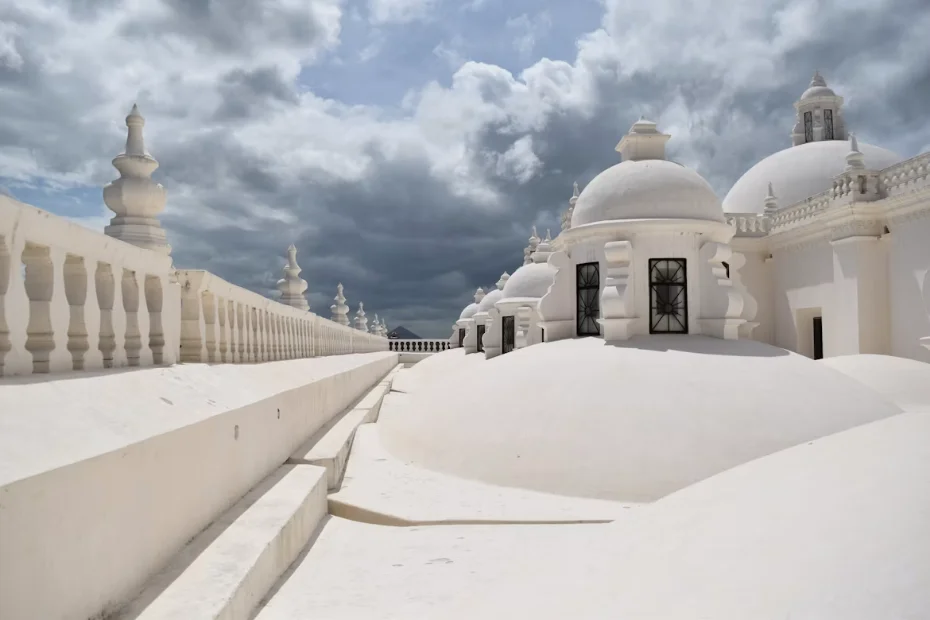
León, further north, is Granada's louder, hotter, more political cousin — a university town with revolutionary murals on its walls and a vast white cathedral, listed by UNESCO, whose roof you can walk across barefoot under a punishing sun, the volcanoes ranged along the horizon. It's also the launch pad for the country's strangest thrill: volcano boarding down Cerro Negro, a young black scree cone where you trudge up carrying a plank and then slide down the loose volcanic gravel on it, goggles on, grit in your teeth. I did it badly and laughed the entire way down.
From there I dropped to the Pacific at San Juan del Sur, a scruffy, sun-bleached surf town in the south where I traded the volcanoes for swell and spent a few salt-crusted days failing politely to surf. Out east, on the other coast, the Caribbean Corn Islands keep their own slow rhythm entirely — turquoise water, no rush, and, by every account, no signal to speak of. And near Granada, Masaya's crater still glows: after dark you can stand at the rim and watch real lava shifting orange far below, the planet showing you its insides.
📶 Romain's tip
Nicaragua isn't in the EU, so there's no roam-like-at-home here — a local data eSIM is the move. Coverage is reliable in Granada, León and Managua, gets capricious on Ometepe, and you should treat the Corn Islands as genuinely off-grid: download your maps, ferry times and bookings before you go. Set it up before you fly so it connects the moment you land. Check your phone's compatibility in 30 seconds here and find your plan on the destinations page (if your trip also routes through Europe, a separate EU/EEA plan covers that leg too).
What I take away
Nicaragua gave me more for less than anywhere on this whole journey — bigger lakes, taller volcanoes, kinder strangers, smaller bills. I kept just enough connection to book the next bed and catch the next ferry, then let the signal fade as I crossed the water and looked up at two volcanoes floating on an inland sea. The lava at Masaya still flickers behind my eyes when I close them. Some countries you visit; this one I'm fairly sure I'll have to come back to.
— Romain, on a lake the size of a sea, watching the volcanoes breathe.