
Mauritius: turquoise lagoons, jagged mountains and tea country
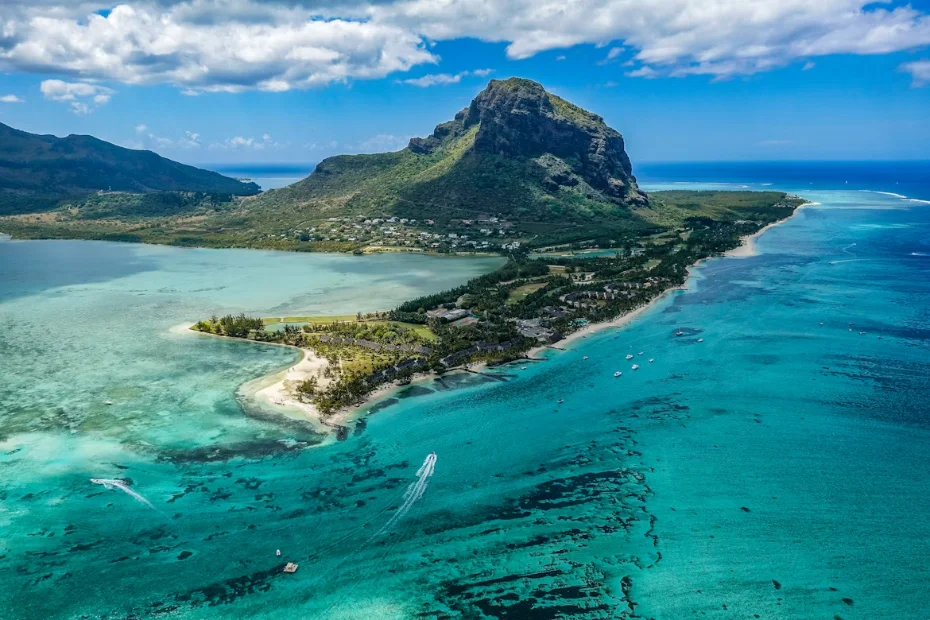
I'll be honest: I almost let Mauritius stay a postcard. The brochures had done their work — turquoise lagoon, white sand, a hammock between two palms — and for a day or two I lay in exactly that picture at Belle Mare and let the warm water do the talking. It was lovely. It was also, I slowly realised, about a tenth of the island. So I rented a small car, learned to drive on the left, and went looking for the rest.
The rest, it turns out, has teeth. Drive twenty minutes inland from any beach and the land buckles upward into jagged peaks — the three humps of the Trois Mamelles, the impossible thumb of Pieter Both with its boulder balanced on top like a trick. Mauritius isn't only a lagoon with a resort on the edge. It's a volcanic island with mountains, tea fields, a sacred lake and a capital that smells of cumin and the sea, all packed onto something you can cross in an afternoon.
The lagoon, and the mountain that remembers
The reef is the island's quiet hero. It rings almost the whole of Mauritius, breaking the open ocean far offshore so that what reaches the beach is that flat, impossibly clear water — a lagoon you can wade into thigh-deep and still see your feet. At Belle Mare I swam at dawn before the sun got fierce; in the southwest, the great basalt monolith of Le Morne Brabant rose straight out of it, and I climbed part-way up one morning with a local guide.
He told me, gently, what the mountain holds. Le Morne was a refuge for escaped slaves, who hid in its caves and on its near-vertical slopes; the cliffs carry a hard, much-told story of people who chose the drop over recapture. It's a UNESCO site now, a place of memory for the whole island's Creole identity. I went quiet on the way down. Some views you don't photograph straight away — you just stand in them, and let the place say what it needs to.
« An island you can cross in an afternoon, holding an ocean of stories on every slope. »
A word on staying connected, since that's what we do here. On an island this small the network is mostly good — in Port-Louis, along the coast road, around the resort towns of Belle Mare and Flic en Flac, I had usable 4G the whole time, enough to map a route or send a photo home. The gaps were where you'd guess: deep in the mountainous interior on the road up to Chamarel, the signal thinned to a single bar and sometimes blinked out behind a ridge, and a couple of the wilder, emptier lagoons in the south had me checking the bars in vain. None of it was a problem so long as I stopped expecting coverage everywhere — I downloaded an offline map before heading into the hills, and let the quiet be quiet.
Up into the colours: Chamarel, Bois Chéri, Grand Bassin
The interior is where Mauritius surprised me most. At Chamarel, the earth itself does something I still can't fully explain — a field of bare dunes striped in seven colours, rust and violet and ochre folded into each other like spilled paint, and a tall waterfall plunging into the gorge a short walk away. Higher up, the hills turn the deep green of tea: at Bois Chéri the plantation rolls away in neat rows, and I drank a cup of the local brew on a terrace looking over the bushes it came from, the whole valley smelling faintly of warm leaf. And tucked in a crater nearby lies Grand Bassin — Ganga Talao — a lake the Hindu community of Mauritius holds sacred, ringed by temples and tall statues, hushed and devotional. I left my shoes, kept my voice down, and was simply a guest.
Port-Louis, and the island on a plate
I'd saved the capital for a market morning, and Port-Louis rewarded it. The central market is a press of colour and noise — pyramids of lychees and pak choi, vanilla pods, stalls of fabric, the call-and-answer of vendors — and the food is where the whole island makes sense at once. Mauritius was built by people from India, Africa, China and France, and you eat all of it in a single street: a dholl puri folded around curry from one cart, fried noodles the next, a Creole rougaille simmering somewhere behind. I ate standing up, fingers messy, more or less continuously. If you want to understand a place, I've found, you start where it cooks.
📶 Camille's tip
Mauritius sits in the Indian Ocean, well outside the EU/EEA, so European roam-like-at-home won't follow you here — sort your data out before you fly. The good news: it's a small island with mostly solid coverage, so a local eSIM keeps you mapped and reachable across the coast and in Port-Louis from the moment you land. Just download an offline map before you drive into the interior — the road up to Chamarel and a few of the emptier southern lagoons have real signal gaps. Check your phone's compatibility in 30 seconds here and find your plan on the destinations page (if a European stopover is bolted onto your trip, an EU/EEA plan covers that leg separately).
What I take away
Mauritius gave me far more than the lagoon I came for, though the lagoon alone would have been enough. What I keep is the layering of it: turquoise water in the morning, a mountain heavy with history by noon, coloured earth and sacred water in the afternoon, a market that tastes of four continents at once — all within a day's slow loop. The beach is real and it's wonderful. But drive past the resort wall, drive up into the green, and the island opens like a hand.
— Camille, salt still in my hair, somewhere on the road between the lagoon and the tea.