Cyprus: divided Nicosia, Paphos and the Troodos mountains
I landed in Cyprus expecting a beach island and found something stranger and more moving — a place that holds two worlds at once. They call it the island of Aphrodite, born from the sea foam off a rock on the south coast, and I'll get to that rock. But my first real memory is of Nicosia, the capital, and of walking up a narrow lane until it simply stopped at a checkpoint, sandbags and a blue United Nations sign, the city continuing on the other side of a line I couldn't cross without my passport. Cyprus is divided, and rather than tiptoe around it I decided to look at it honestly, the way you'd look at any old scar — with respect, and without taking a side.
I'd given myself a week, a small rental car, and a loose plan built around three things: the capital, the mosaics of Paphos, and the mountains. What I didn't plan for was how much of the trip would happen at a table, halloumi squeaking between my teeth, the meze plates arriving faster than I could finish them.
Nicosia, the last divided capital
Nicosia — Lefkosia to the Greek-speaking south, Lefkoşa to the Turkish-speaking north — is the only capital in Europe still split in two. A buffer zone patrolled by the UN, the so-called Green Line, runs straight through the old Venetian walls, and the contrast hits you on foot more than any map could. I spent a morning in the southern old town, all bougainvillaea and craft shops, then walked to Ledra Street, where one of the pedestrian crossing points lets you step across with your passport. On the northern side the call to prayer drifted over the rooftops and the great Selimiye mosque revealed itself to be a Gothic cathedral with minarets bolted on — Lusignan stone, Ottoman use, layered like everything here. I'll stay factual about the politics, because it isn't mine to litigate: there is a line, there are crossings, and people live full lives on both sides of it.
« In Nicosia you can drink your morning coffee in the European Union and your afternoon tea outside it, and walk the whole distance in twenty minutes. »
That short walk is also where I have to be honest about your phone, because it caught me off guard. The Republic of Cyprus — the south — is in the European Union, so the European « roam-like-at-home » rule applies and my plan just worked, fast and unbothered, the way it would in Greece or Spain. But the moment I crossed into the north, my phone latched onto a Turkish network, and that is outside the EU. « Roam-like-at-home » does not cover it, and roaming charges can land without warning. I'd switched my data off before stepping across and turned it back on once I returned south — a thirty-second habit that saved me a nasty surprise.
Paphos, mosaics and the rock of Aphrodite
I drove southwest to Paphos, where the past is underfoot in the most literal way. In the archaeological park, under modern shelters, lie the Roman mosaics of the House of Dionysos — whole floors of hunting scenes and myths picked out in tiny coloured stones, sharp enough after eighteen centuries that I crouched for a long time over a leopard's spotted flank. It's UNESCO-listed, and you can see why. Nearby, the Tombs of the Kings are cut straight into the rock above the sea, grand subterranean courtyards that never held a single king but earned the name through their scale. Then, on the coast road, I pulled over at Petra tou Romiou — the sea-stack where legend says Aphrodite rose from the waves. It was just a pale rock in a hard blue sea, and somehow that made it better; I sat on the pebbles and let the surf do the talking.
The Troodos mountains, painted churches and a long table
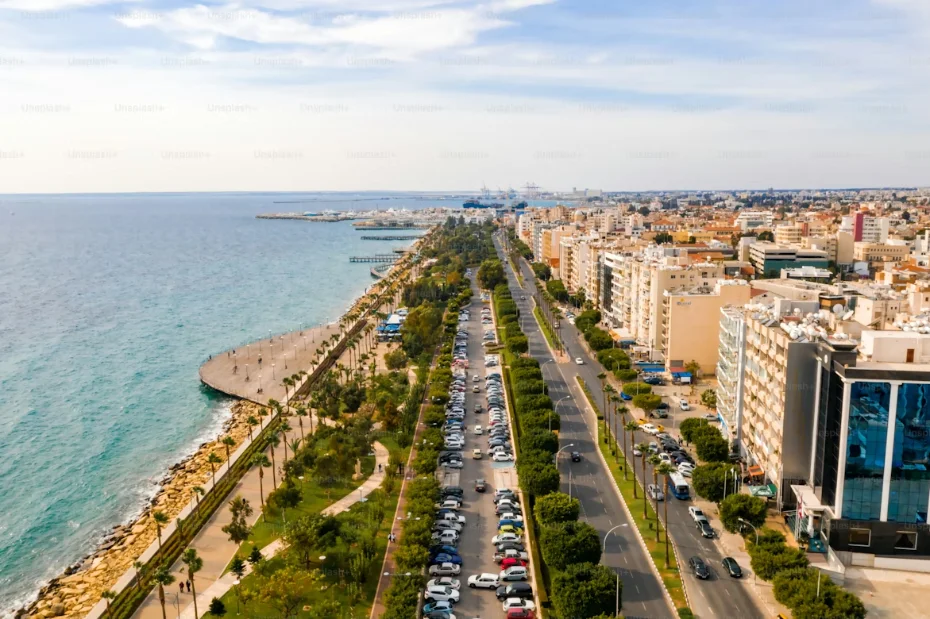
Inland and upward, the Troodos mountains were the part I didn't know I'd love most. The road climbs through pine forest into stone villages where old men play backgammon in the square and the air smells of resin and woodsmoke. Tucked into these hills are small Byzantine churches whose plain barn-like roofs hide interiors covered floor to ceiling in painted saints — several of them collectively UNESCO-listed, and standing in one, alone, neck craned, was the quietest I went all week. Higher still I reached Kykkos, the great monastery wrapped in gilded mosaics and the smell of incense. I came back down to a taverna in Limassol on the coast and a meze that would not end: grilled halloumi, olives, slow-cooked lamb, and a tiny glass of commandaria, the sweet amber wine they've made on this island since antiquity.
📶 Nora's tip
The Cyprus subtlety is worth understanding before you go. The Republic of Cyprus (the south) is in the EU, so your European « roam-like-at-home » plan works there normally and coverage is strong across the towns, the coast and even most of the Troodos roads. But in the north, your phone tends to connect to Turkish networks that are outside the EU, where « roam-like-at-home » does not apply and roaming charges can appear — so switch data off before crossing the Green Line, or check your operator's rates first. Check your phone's compatibility in 30 seconds here and find your plan on the destinations page (since the south is in the EU, an EU/EEA plan covers it nicely, and works for a broader European trip too).
What I take away
Cyprus gave me more than the beach island I'd half-expected. It gave me a capital you walk across in minutes and a lifetime of history at once, mosaics sharp enough to touch, painted mountain churches that made me whisper, and a generosity at the table that I felt every single day. It's an island living between two worlds, gracefully and without fuss — and the only homework it asks of you is to know, before you cross that one line, which world your phone is talking to.
— Nora, halloumi on my plate and salt on my skin, on the island of Aphrodite.