
Azerbaijan: Baku, the Caspian and the fires of the Caucasus
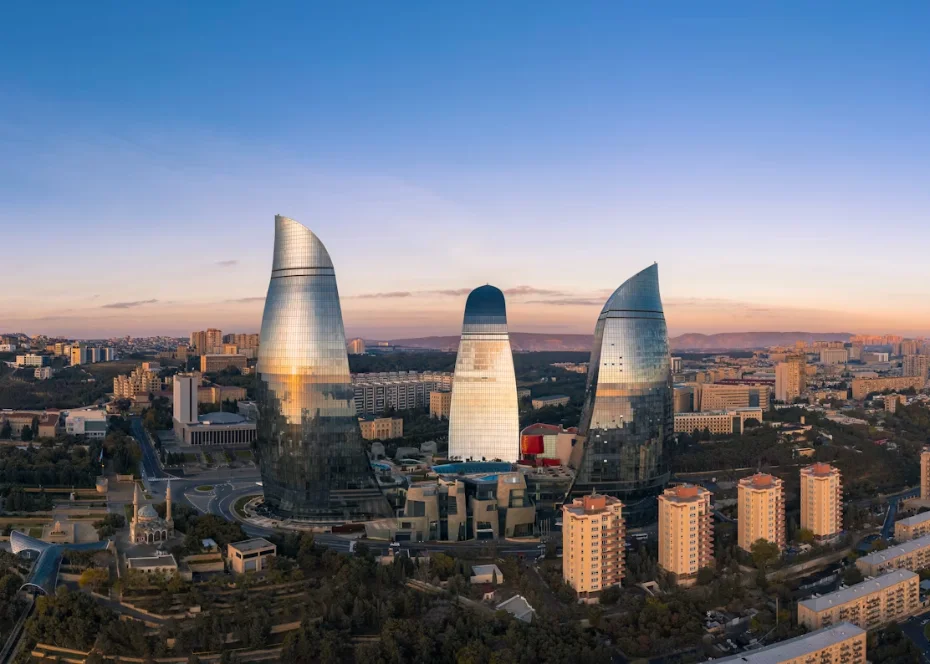
Azerbaijan is where the map starts to hesitate. Europe or Asia? The country keeps a foot on each side and seems amused that you'd even ask. I'd crossed the Caucasus from Armenia not long before — same mountains, same fierce love of stone and tea, and a border between the two that politics has kept firmly shut, so you fly the long way round and pretend the map is simpler than it is. I landed in Baku with a week, a vague plan, and the standing instruction every Caucasus traveller learns fast: don't expect the neighbours to make sense together.
The plan, loosely: a few days in the capital, then south to the mud volcanoes and the petroglyphs, a colline that has been on fire for as long as anyone remembers, and a long drive north into the Grand Caucasus to a town of caravanserais. Baku would be the easy part. Everything after it, I suspected, would ask a little more of me — and of my phone.
Baku, medieval walls under glass towers
Baku does a thing few cities pull off: it puts the eleventh century and the day after tomorrow in the same frame and lets you sort it out. Inside Icheri Sheher — the walled old town, on the UNESCO list — the lanes are cool and crooked, cats own the doorsteps, and the Maiden Tower stands there stout and unexplained, nobody quite agreeing what it was for. A few streets on rises the Palace of the Shirvanshahs, all honeyed stone and quiet courtyards. Then you walk out of the gate, look up, and the Flame Towers are burning above the skyline in LED fire — three glass blades that the city lights up at night like a thing showing off, which it is. Out past the centre, the Heydar Aliyev Center pours itself across the ground in white curves, a Zaha Hadid building with no straight lines anywhere in it, as if someone poured cream and it set mid-flow.
And then the water. The Caspian — the largest enclosed body of water on the planet, a sea by courtesy and a lake by definition — lies flat and grey-blue along the boulevard, and you walk its edge in the evening with half of Baku, eating ice cream, no one in a hurry. This is the easy part for connectivity, so I'll say it plainly: Baku is well covered. Azerbaijan is outside the EU, so there's no roam-like-at-home here — a European plan does not follow you across this border — but a local data eSIM had me online before I'd cleared passport control. In the city I could translate a menu, check a museum's hours, find the right manat note to hand over, all without thinking. It's the country beyond the city that asks for foresight, and I'll get to that.
« A walled medieval town wearing three towers of fire — Baku stops pretending you have to choose an era. »
One thing I'll say carefully, because it isn't mine to gloss over. Azerbaijan and Armenia have fought, for a long time and recently, over Nagorno-Karabakh, and the wounds are very present — you feel it in the closed border, in the flags, in the things people say and don't say. I travelled in both countries within the same trip, and I won't pretend to settle from a café table what armies and diplomats have not. I'll only note that the warmth I was shown in Baku was as real and as unguarded as the warmth I'd been shown in Yerevan, and that both can be true at once.
Fire and mud: Yanar Dag and Gobustan
You don't fully believe the fire until you're standing in front of it. Yanar Dag is a low hillside on the Absheron peninsula where natural gas seeps from the rock and simply burns — a wall of flame a couple of metres high, day and night, no one feeding it, hissing quietly in the dark. Azerbaijan's old name, the « land of fire », stops being a tourism slogan and becomes a literal description of the ground. South of the city, Gobustan is the other half of the same strange geology: a UNESCO-listed field of petroglyphs, thousands of figures scratched into the rock by people who stood here millennia ago, and beyond them the mud volcanoes — squat grey cones burping cold mineral mud with a sound like the planet thinking. I climbed among them with mud on my boots and the Caspian glittering far off, and felt very small in the good way.
Out here the signal starts to behave like the weather — present near the road, thinner once you walk out to the cones. I'd downloaded an offline map of the Gobustan loop before leaving Baku, the same reflex every road trip teaches you, and I was glad of it on the dirt tracks where the bars quietly dropped and stayed down.
North to Sheki and the Grand Caucasus
The long day was the drive north and west, up toward the Grand Caucasus, to Sheki. The road climbs out of the dry lowlands into green folded hills, and the town sits in them like something half-forgotten on purpose: old caravanserais where Silk Road traders once stabled their camels, now cool stone courtyards you can sleep in, and the Khan's Palace — a small summer residence with no nails in its wooden lattice and stained-glass windows assembled pane by tiny pane, called shebeke, throwing coloured light across painted walls. I drank black tea poured dark from a pear-shaped glass, with a spoon of cherry jam on the side to bite between sips the way they do here, and ate until I couldn't. This is a Shia-majority country that wears its faith lightly and its secular state plainly, and the hospitality is its own quiet religion.
It's also where the network gave up the cleanest argument for planning ahead. Up in the mountain folds around Sheki — and further out toward Quba and the remote valleys — coverage turns moody, present in town and gone on the passes between. Nothing dramatic, just the ordinary truth of mountains: the connection thins where the road climbs. I kept the day's route saved offline before leaving the last town with a solid signal, and let the rest go.
📶 Thomas's tip
Azerbaijan is not in the EU, so roam-like-at-home does not apply — your European plan won't follow you here. Take a dedicated Azerbaijan data eSIM and install it before you fly, so you're live the moment you land at Baku. The capital and the main towns are genuinely well covered and you can improvise; it's the Grand Caucasus around Sheki and Quba, and the dirt tracks out to the Gobustan mud volcanoes, where it goes quiet — so always download an offline map of the day's route before leaving the last town with a solid signal. Check your phone's compatibility in 30 seconds here and find your plan on the destinations page (and if you're stitching on a European stopover on the way, an EU/EEA plan covers that separate leg).
What I take away
Azerbaijan gave me the disorientation I quietly look for — a place that won't be filed neatly under one continent, one era, one easy story. Fire that comes straight out of the ground, mud that talks, a medieval town living under towers of light, and a sea that is technically a lake the size of a country. Baku kept me connected enough to wander on a whim; the mud volcanoes and the mountain roads asked me to plan ahead and then, gently, to put the phone away. And the Caucasus left me with something heavier and worth carrying: two neighbours I came to love within a single trip, a border closed between them, and no tidy ending to offer either. I'd go back — and I'd plan the signal the same way.
— Thomas, tea going cold by a wall of fire on the Absheron.