
Saudi Arabia: AlUla, the tombs of Hegra and the desert
For most of my life Saudi Arabia was, to me, a closed door — a country you flew over, or transited through, but didn't simply visit. That changed in 2019, when the kingdom started issuing tourist visas, and I'd been waiting ever since for a good reason to go. The reason turned out to be a row of tombs cut into pink sandstone in the middle of the desert, carved by the same hands, in the same century, as the more famous ones at Petra. I went for the stones. I stayed for the silence around them.
My loose plan was a triangle: AlUla in the northwest for the Nabataean tombs of Hegra, then back through Riyadh for the capital and the cliff they call the Edge of the World, and finally down to Jeddah on the Red Sea, the old pilgrim port. A few things I knew going in, and want to pass on plainly: dress modestly, alcohol is simply not available, the weekend runs Friday–Saturday, and you pay in Saudi riyals. None of it slowed me down; it just shaped how I moved.
Hegra: Petra's quiet sibling
AlUla is a long way from anywhere, and that's the point. I flew in, picked up a permit for the site, and the next morning stood in front of Hegra — Madâin Sâlih on the old maps — the first place in Saudi Arabia to be inscribed on UNESCO's World Heritage list. More than a hundred tombs stand in the open desert, their facades cut straight into freestanding outcrops of sandstone, and because so few people are here, you often get a whole tomb to yourself. It's the same Nabataean civilisation as Petra, the same confident geometry over the doorways, but with none of the crowds. I kept thinking I'd wandered onto a film set that everyone had forgotten to populate.
« Same carvers as Petra, same pink sandstone — and, on the morning I stood there, almost no one to share it with. »
A word on staying connected, honestly, because it matters most where it's weakest. Saudi Arabia is not in Europe, so there's no roam-like-at-home arrangement to lean on — you're on a proper local data plan or nothing. In the towns it's excellent; out at AlUla it was decent enough near the visitor areas and the old town, the kind of signal that holds for a map and a message but not for much streaming. I'd activated my eSIM the moment I landed, which let me book my Hegra slot and the shuttle without hunting for wifi. Out among the tombs themselves I mostly put the phone away — not because it didn't work, but because it felt wrong to.
The old town, Jabal Ikmah, and a mirror in the desert
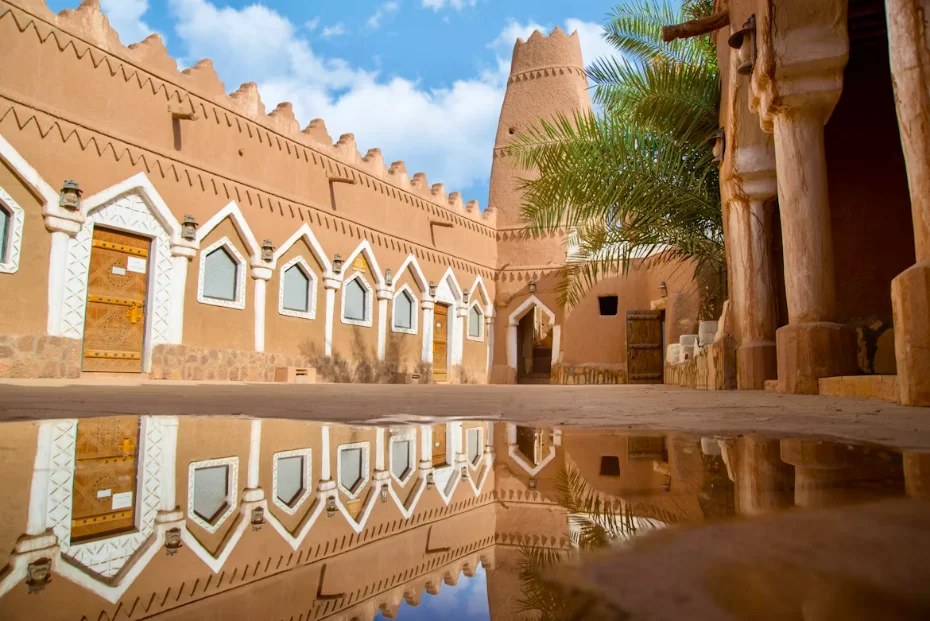
AlUla isn't only Hegra. There's the old town just down the road — a tumble of mudbrick houses you can walk through at dusk — and Jabal Ikmah, a narrow canyon whose walls are covered in inscriptions in old scripts, an open-air library scratched into rock over centuries. And then, jarringly and wonderfully, there's Maraya: a concert hall sheathed entirely in mirrors, so that the cliffs and the sky wrap around it and it nearly disappears. Old and new sit very close together here, and the kingdom clearly wants you to notice. I didn't mind being shown; the contrast was honest.
The Edge of the World, Diriyah, and the Red Sea port
Riyadh is the other Saudi Arabia — a sprawling, fast capital in the heart of the Najd, where the Kingdom Centre tower splits the skyline. I used it as a base for two very different days. One was Diriyah, the birthplace of the Saud dynasty, whose At-Turaif district is its own UNESCO site, all warm mudbrick walls glowing at golden hour. The other was the Edge of the World, an escarpment a couple of hours out of the city where the land simply stops and falls away to a hazy plain far below. Out there the signal frayed and then quit — fine for the cities, gone the moment you're standing on the rim — so I'd downloaded an offline map and told the driver our turnaround time before we lost it.
I finished in Jeddah, on the Red Sea, in the old quarter of Al-Balad — itself UNESCO-listed — where tall coral-stone houses lean over the lanes behind carved wooden screens. Jeddah has always been the gateway to Mecca, and here I'll be precise, because travellers ask: Mecca and Medina are closed to non-Muslims, so as a visitor you experience this as the port that received pilgrims, not the holy cities themselves. The distinction is real and worth respecting. Back in town the network was effortless again, full city coverage, and I let myself get properly lost in Al-Balad knowing the map was always a tap away.
📶 Malik's tip
Saudi Arabia sits outside Europe, so there's no roam-like-at-home here — get a proper local data plan and have your eSIM installed and active before you land, so you can sort your Hegra permit and transfers from the arrivals hall. Expect strong, fast coverage in Riyadh and Jeddah, decent service around AlUla's visitor areas, and patchy-to-none in the deep desert — at the Edge of the World, assume you'll be offline, so download an offline map and agree a turnaround time before you set out. Check your phone's compatibility in 30 seconds here and find your plan on the destinations page (for a broader European trip, an EU/EEA plan works too).
What I take away
Saudi Arabia gave me the rarest thing a famous wonder can offer: room to breathe. Standing at Hegra with almost no one around, I felt I'd caught a place in the brief window before the world fully arrives. The kingdom is new to visitors and still finding its feet with us, and a traveller does well to come curious, dress with respect, and take the local customs at face value. The signal followed the same logic as the country — generous in the cities, thinner in the sand — and the deserts, here as everywhere, were better for the times I let the phone go quiet.
— Malik, somewhere between a Nabataean tomb and the edge of a cliff, watching the light go pink on old stone.