
Zambia: Victoria Falls, the Zambezi and the walking safari
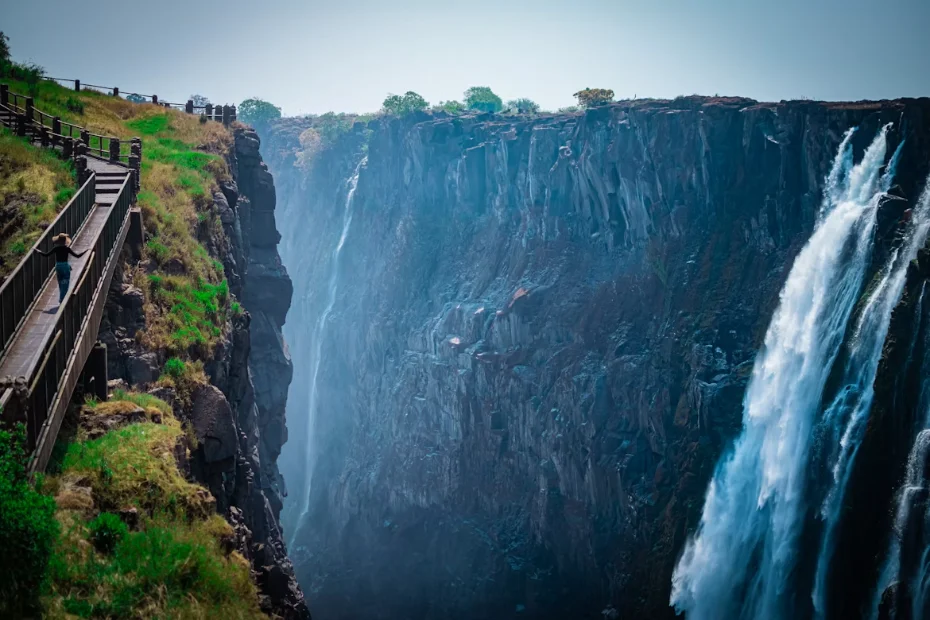
You hear Victoria Falls before you see them. Not as a sound exactly, more as a pressure — a low, continuous thunder that rises out of the ground and gets into your chest as you walk the path from Livingstone. The local name says it better than any postcard ever could: Mosi-oa-Tunya, the smoke that thunders. From a kilometre away you can already see the spray, a white column climbing off the gorge into a blue sky, drifting sideways on the wind like a fire that never goes out.
I'd come at the tail of the high-water season, late May, when the Zambezi is still heavy and the falls are at their loudest. The trade-off is honest: at full flow you barely see the curtain of water through the spray, and you come back soaked to the skin, grinning, having photographed mostly a wall of mist. I didn't mind. There's something humbling about standing at the lip of a gorge while a river the width of a mile throws itself over the edge and the air itself turns to rain.
The smoke that thunders
Livingstone is the Zambian side of the falls — the town named after the explorer, a low, easy place of dusty streets, curio markets and the kind of warmth that makes you slow down. The falls themselves are shared with Zimbabwe, the border running right down the middle of the gorge, and the old Victoria Falls Bridge stitches the two countries together over a drop that makes your knees a little uncertain. I walked out onto it at dusk, watched a bungee jumper fall and bounce against the roar below, and decided some things are better admired than attempted.
If you come in the low-water months — roughly September to December, though it shifts year to year — the river drops and a strange ritual opens up on the Zimbabwean lip: Devil's Pool, a natural rock basin where you can reportedly sit at the very brink with the water sliding past your shoulders into the void. I was here in the wrong season for it, the flow far too strong, so I'm passing that on second-hand rather than pretending I balanced on the edge myself. File it under "come back in October."
« The smoke that thunders gets into your chest before it reaches your eyes. »
A word on staying reachable, since it shapes the whole trip. Zambia is well outside Europe, so no home-roaming arrangement follows you here — and the country splits cleanly in two for a phone. In Livingstone and the capital, Lusaka, coverage is genuinely fine: I sent photos, booked a transfer, paid for a few things without trouble. Out in the parks it's another world entirely, and I'll get to that. I sorted my data before flying and had it live the moment I landed, which is the only part of Zambian connectivity you actually control.
Walking the South Luangwa
From the falls I flew northeast to the South Luangwa, and this is where Zambia tells its real story. This is the place credited with inventing the walking safari — the idea, decades old now, that you leave the vehicle behind and explore the bush on foot, in single file behind an armed guide and a scout, reading tracks instead of driving over them. It rearranges the whole experience. In a jeep you're a spectator; on foot you're a small, soft thing in someone else's kingdom, and you feel it in your spine.
My guide, Mwamba, walked slowly and talked quietly, stopping us with a raised hand to point out things I'd have trampled — a leopard's pugmark pressed into the dust, a hippo path worn smooth, a termite mound the size of a small car. The Luangwa is famous for its leopards, and on a night drive I finally saw one: a long, unhurried shape crossing the track in the spotlight, glancing back once, gone. No photo. Just the memory, and the sound of my own held breath. Out here there was no signal at all, and the lodge ran on a generator and lamplight. That's normal for the Luangwa, and after a day I stopped reaching for the phone that had nothing to give me.
The Lower Zambezi by canoe
I gave my last days to the Lower Zambezi, downstream of Lusaka, where the river runs wide and slow between Zambia and Zimbabwe. Here you trade your feet for a canoe, drifting the channels with a guide steering from the stern, and the wildlife comes to the water to meet you. We slid past elephants standing belly-deep, crossing the river in a line with their trunks raised like snorkels; gave a wide, respectful berth to pods of hippos that own these waters and know it; watched a fish eagle drop and rise with something silver in its talons. Paddling at water level, eye to eye with the bank, is about as close to the river's own perspective as you can get.
The Lower Zambezi is another deep dead zone — the lodges are largely offline, a few with a satellite link at reception for emergencies and not much more. I'd made my peace with that before I left, told the people who worry about me that I'd be quiet for a stretch, and let the river fill the silence. Lusaka, when I passed back through at the end, felt almost loud by comparison: the phone buzzing awake with a week of missed messages, the city moving fast, kwacha changing hands at the market, the whole connected world switching back on at once.
📶 Yann's tip
Set your eSIM up before you fly and get it live in Livingstone or Lusaka, where the network is solid — you'll want it for transfers, flight confirmations and a last round of messages before you head into the bush. Then plan around the dead zones instead of fighting them: South Luangwa and the Lower Zambezi are largely offline, so download an offline map, tell people you'll be quiet, and treat the two cities as your windows back online. Check your phone's compatibility in 30 seconds here and find your plan on the destinations page (if your route also takes in a separate European leg, an EU/EEA plan covers that side of the trip).
What I take away
Zambia gave me two kinds of overwhelming. The first was the falls — pure noise and water and spray, a sensory wall you can't argue with. The second was the opposite: the long, attentive quiet of the bush, where you walk softly and the only notification is a leopard crossing a track. I came home a little deaf in one ear from the Zambezi's thunder and a little calmer in the head from its silence, which is a fair trade for a country that does both extremes so well. The smoke is still thundering somewhere, with or without me there to hear it.
— Yann, still soaked to the bone and grinning at the edge of a gorge.