
Egypt: the Nile, the pyramids and a taste of the desert
I came to Egypt for the rivers and the deserts, and ended up staying for the sheer weight of time. You feel it the moment you land in Cairo: a city of twenty-something million people pressed against the edge of the Sahara, where a flyover ramp can give way, without warning, to the silhouette of pyramids that were already ancient when Rome was a village. I've chased old stones across half the world, but nothing prepared me for that first glimpse of Giza from the back of a taxi stuck in traffic.
My plan was simple and, I'll admit, a little classic: a few days in Cairo and Giza, then south to Luxor to board a boat and let the Nile carry me to Aswan. A river, some temples, and — because I can never resist — a taste of the desert at the edges. What I didn't fully plan for was how the signal would shape the trip: generous in the cities and along the river, then quietly vanishing the moment the sand took over.
Cairo, Giza, and the first morning
Cairo doesn't ease you in. The Egyptian Museum alone could swallow a day — I spent a long, dizzy hour in front of Tutankhamun's gold before I had to step outside and breathe. But the morning I really came for was Giza. I'd booked a guide the night before from my hotel, and getting that confirmed was my first real use of the eSIM: a flurry of messages, a pin dropped for the meeting point, a quick call to nail down the time. In Cairo the connection was honestly fine — I had data the whole way out to the plateau, enough to read up on the Sphinx while we crawled through the morning traffic.
Standing at the foot of the Great Pyramid, you stop talking. There's a point where the scale just shuts you up. I sent my brother a short video — no commentary, because what would I even say — and the upload went through without a fuss. That's the thing about Cairo and Giza: as a visitor you're well covered, and you can lean on your phone for transfers, tickets, and the occasional « I'm still alive, look at this » to people back home.
Down the Nile, Luxor to Aswan
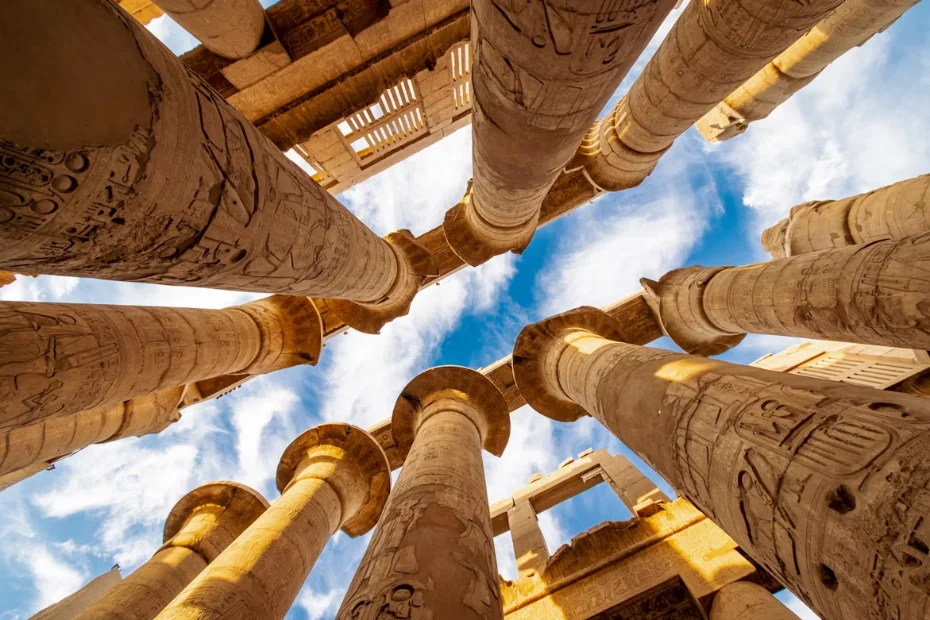
Then came the part I'd been dreaming about. The flight south to Luxor is short, and within a day I was standing in the forest of stone columns at Karnak, neck craned, feeling appropriately small. Across the river, the Valley of the Kings hides its tombs in a dry, blinding valley — you climb down into painted corridors that have held their colours for three thousand years, and you come back up blinking into the heat, a little changed.
« The Nile has been carrying travellers for five thousand years. I was just the latest, with a phone in my pocket and no idea what to do with myself for three days. »
The cruise itself, from Luxor to Aswan, is a slow, civilised drift — a few days of temples by morning and the riverbank sliding past in the afternoon. Egret-white birds, palm groves, kids waving from the shallows, the occasional felucca with its single triangular sail leaning into the wind. On board there was patchy wifi, and my eSIM held a signal more often than I'd expected, because the river is also where the towns are — the Nile is the country's spine, and the network tends to follow it. It dropped between settlements, came back near the locks and the riverside villages, and was solid again whenever we tied up at a town like Edfu or Kom Ombo. I used it to confirm a felucca ride at Aswan and to message the driver who'd meet me at the dock — small, practical things that made the whole logistics knot untie itself.
A taste of the desert
I couldn't be this close to the Sahara and not touch it. From Aswan I took a short trip out toward the desert's edge, and that's where the honesty has to come in: out there, the bars on your phone simply leave. The desert doesn't care about coverage. Once you're past the last village, you should assume you're offline — and I'd argue that's part of the gift. I'd downloaded an offline map and told someone my rough plan before I lost signal, which is just sensible. For an hour I sat on warm sand watching the light go gold over nothing at all, completely unreachable, and it was one of the best hours of the trip.
📶 Malik's tip
Have your eSIM installed and active before you land in Cairo, so you can sort your Giza guide and airport transfer from the arrivals hall. In the cities and along the Nile, plan on usable data — enough to confirm feluccas, drivers, and cruise transfers. In the desert, assume you'll be offline: download an offline map and share your plan before you head out, and treat the silence as a feature. Check your phone's compatibility in 30 seconds here and find your Egypt plan on the destinations page (heading on to Europe afterward? a regional EU eSIM covers you there too).
What I take away
Egypt gave me the two things I always travel for and rarely find together: the deep, almost unbearable past of the temples, and the clean emptiness of the desert. The river ties them together, and so, in a smaller way, did the signal — there when I needed to arrange the next felucca or reassure my family, gone when the sand wanted me to put the phone away. I didn't fight that. I planned around it, and it made the connected moments mean more and the disconnected ones mean everything.
— Malik, somewhere between a river and a dune, watching the light go gold.