Botswana: the Okavango by mokoro, Chobe and the Kalahari
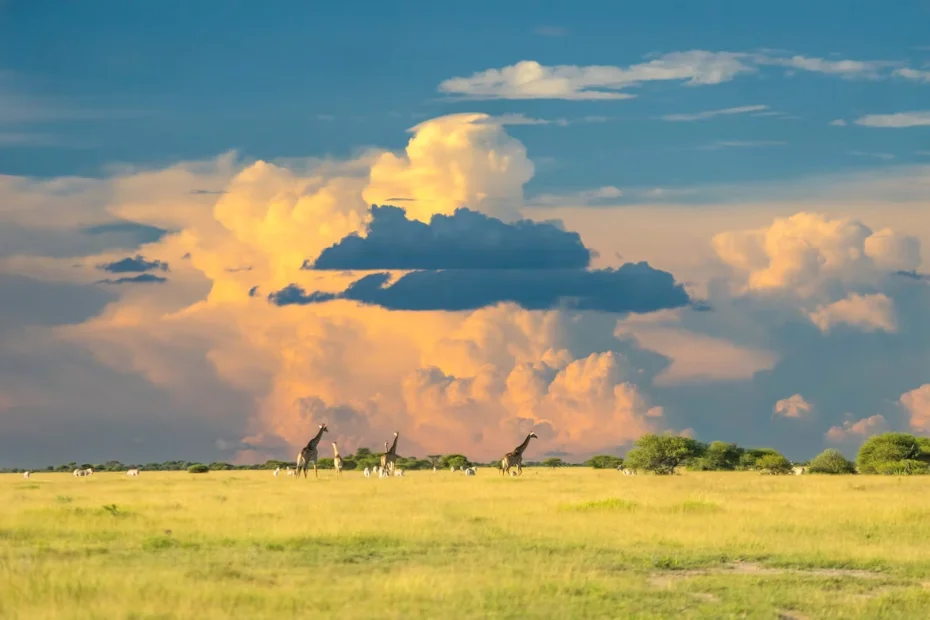
There's a particular kind of quiet you only find on water that isn't going anywhere. The Okavango is an inland delta — a great river that pours down from the Angolan highlands and, instead of reaching a sea, fans out and simply disappears into the Kalahari sands. I'd read that sentence a dozen times before I came. It only made sense the morning I sat low in a mokoro, knees almost at the waterline, while a guide stood behind me and pushed us through the reeds with a single long pole.
I'd flown in the day before from Maun, the dusty gateway town where every Botswana trip seems to begin. The bush plane held about eight of us, the pilot doubling as baggage handler, and the flight was short and very low — long enough to see the delta from above, a green and silver maze of channels and islands with no road in sight. That's the deal here: many of the camps have no road at all. You arrive by air, and the landscape stays wild because so few people ever reach it.
Poled through the reeds
The mokoro is the delta's oldest way to move, and the most honest. No motor, no fumes — just the soft knock of the pole finding the bottom and the hiss of the hull through papyrus. My guide, Onkemetse, had grown up on these channels and read the water like a street he'd known all his life. He'd stop the boat with a small lean of the pole, point with his chin, and there it would be: a reed frog the size of a thumbnail clinging to a stem, a jacana walking on lily pads as if they were paving stones, the broad wake of something larger we agreed to give a wide berth.
You learn quickly that the delta rewards patience over distance. We weren't going far. We were going slowly, and seeing everything. By the second morning I'd stopped reaching for my phone to photograph each thing — partly because there was no signal to share it anyway, and partly because the camera kept getting between me and the moment.
« No motor, no signal, no hurry — just a pole finding the bottom and the whole delta breathing. »
It's worth being plain about connectivity out here, because it shapes the trip whether you plan for it or not. Botswana sits well outside Europe, so don't expect any home roaming arrangement to follow you in. Maun has a perfectly decent network, and so does Kasane up north — but the delta itself, Moremi, the deep bush camps, these are largely offline. Some camps have a satellite link at reception for emergencies and little else. I downloaded an offline map of the region in Maun, sent the messages I owed people, and then let the silence do its work for a few days.
Chobe and the elephants
From the delta I made my way north to Chobe, and the change of register is dramatic. Where the Okavango whispers, Chobe roars — gently, but at scale. The park holds one of the largest elephant populations on the continent, and in the dry season they come down to the Chobe River in numbers that genuinely reset your sense of proportion. I took the late-afternoon boat cruise, which is the thing to do, and drifted past herds wading and drinking and dust-bathing along the bank, hippos grumbling in the shallows, a fish eagle calling somewhere overhead.
The gateway to all this is Kasane, a small town that feels almost metropolitan after the delta. The signal came back as we approached — phones buzzing awake with everything they'd missed — and I had that slightly comic moment of remembering the outside world still existed. I used the evening to back up photos and send a few, then put the phone down again. Chobe is too good to watch through a screen.
The Kalahari, and the small things
I gave the last stretch to the Kalahari, which surprised me most of all. People picture the desert as emptiness, but the Makgadikgadi pans and the surrounding scrub are full of life that has learned to make do with very little. The headline act, for me, was the meerkats — a habituated group near my camp that, in the cool of early morning, would stand sentinel on a mound and, every so often, decide a visitor made a fine warm perch. Sitting still while a meerkat climbs you to scan the horizon is a strange and lovely thing, and no photograph I took does it justice.
Out on the salt pans the scale flips again: a white, cracked horizon so flat and so vast it plays tricks with your eyes, and a night sky with no town for a hundred kilometres to dilute it. There was no network here at all, of course, and that felt entirely right. A little practical note for anyone tempted: pula, the local currency, is the name for rain — fitting, in a country where water is the whole story — and cards work in the towns, but the bush runs on what you brought with you, signal and cash alike.
📶 Malik's tip
Set up your eSIM before you fly and get it live in Maun, where the network is solid — you'll want it for camp transfers, flight confirmations and a last round of messages before you vanish into the delta. Then plan around the dead zones rather than fighting them: download an offline map, tell people you'll be quiet, and treat Maun and Kasane as your two windows back online. Check your phone's compatibility in 30 seconds here and find your plan on the destinations page (if your route also takes in a separate European leg, an EU/EEA plan covers that side of the trip).
What I take away
Botswana made its choice a long time ago: fewer visitors, paying more, leaving lighter. You feel that in the empty channels and the unbroken horizons, and you feel it in the silence — the literal, network-free kind. I came home with a camera full of elephants and a head oddly clear, the way it gets when you've spent a week unreachable on purpose. The delta doesn't ask you to disconnect. It just makes it the obvious thing to do.
— Malik, still hearing a pole knock against the bottom of a mokoro.