
Ghana: Accra, the Cape Coast castles and the Ashanti kingdom
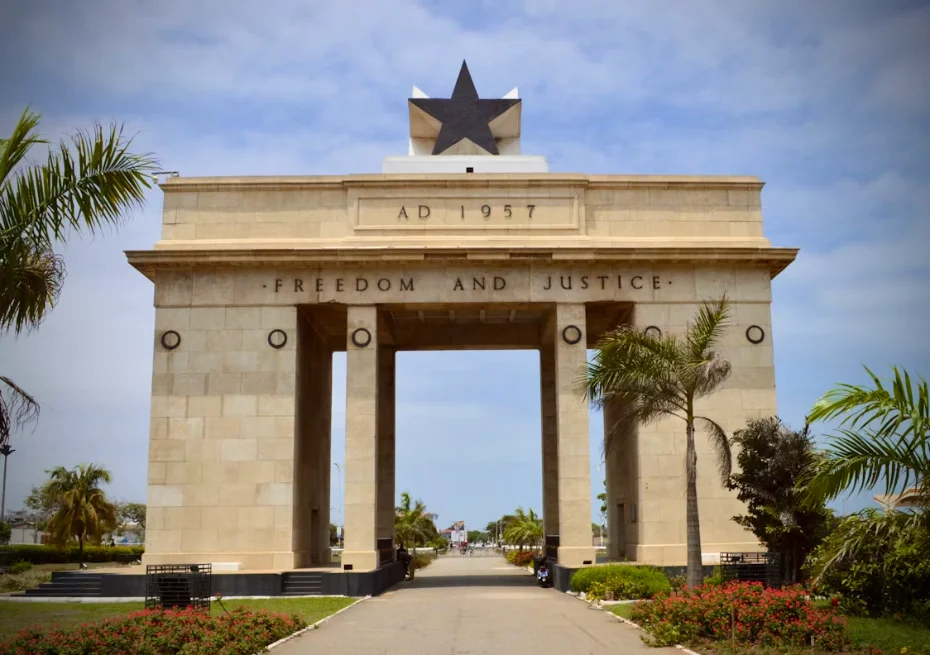
I landed in Accra in the late afternoon, when the heat has lost its edge and the city settles into its long, golden hour. The first thing I noticed wasn't a sight, it was a sound: highlife guitars leaking out of a shopfront, a trotro conductor calling his route, someone laughing two stalls down. Ghana greets you in English, which lulled me into thinking I'd find it familiar — and then everything else, the rhythm, the colours, the warmth of the people, reminded me I was somewhere entirely its own. They call this the gateway to West Africa. I came to take that seriously, and to take my time.
I gave myself two weeks, because some of what I'd come to do should not be rushed. Accra to start, then south to the coast and the forts of Cape Coast and Elmina, a morning up in the canopy at Kakum, and finally inland to Kumasi, the old Ashanti capital. I wanted the whole arc of it — the living city, the grave weight of history, the green hush of the forest, the pride of a kingdom that still beats. Ghana gives you all of that, if you let it set the pace.
Accra, loud and generous
Accra doesn't ease you in; it just opens the door and pulls you through. I started at Makola Market, a vast, churning organism of a place where you can buy fabric, fish, phone credit and herbal remedies within ten paces, and where I quickly learned to smile, say "medaase" — thank you in Twi — and let the crowd carry me. Down by the water I walked Jamestown, the old fishing quarter under its colonial lighthouse, the air thick with woodsmoke and salt, kids playing a ferocious game of football against a sea wall. In the evening I sat with a plate of jollof rice — the one Ghanaians and Nigerians will cheerfully go to war over — and let the highlife and azonto playing somewhere nearby do the rest.
I made one stop that asked for quiet: the Kwame Nkrumah Mausoleum, where Ghana's first president and the architect of its independence lies in a park built to honour him. It's a calm, deliberate place, and it set the tone for the rest of my trip — a reminder that this is a country deeply aware of its own history, and unafraid to face it.
« Ghana greets you in English, then quietly teaches you it is wholly itself. »
Practically, Accra is where staying connected is easiest. Coverage in the capital and across the southern cities was steady — fine for maps, for messaging, for sorting a ride or looking up a market stall's reputation. I'll be honest that this evenness doesn't hold everywhere; further north and out in the rural stretches, signal gets moody. But in Accra I rarely thought about it, which is exactly how connectivity should feel: invisible until you need it.
Cape Coast and Elmina, where you go silent
Some places you don't visit so much as submit to. The slave castles of Cape Coast and Elmina are that. These were forts built by Europeans for the transatlantic slave trade, and within their whitewashed walls hundreds of thousands of African men, women and children were imprisoned in the dark before being forced onto ships and carried across an ocean, never to return. I walked down into the dungeons — low, airless, the stone still scarred — and there are no words I can offer that the place doesn't say more honestly itself. You stand there, and you are quiet, because silence is the only adequate response.
At the end of the passage is a doorway the guides call the Door of No Return: the threshold through which the captured were marched onto the beach and the waiting ships. I will not describe it as anything other than what it is — the last point at which a person, stolen from their home, stood on African ground. I went through it slowly. On the other side, the Atlantic. I have rarely felt the weight of history press so physically on a body. This is not a sight to photograph for a feed. It is a place to bear witness, and to carry out with you, gently, what it asks you to remember.
I want to be plain about why I went. Not for spectacle, and not to tick a box, but because this history belongs to all of us, and standing in the room where it happened is a form of respect the books can't reach. Both Cape Coast and Elmina are kept as memorials, with guides who speak with a measured, unflinching dignity. Go if you can. Go ready to be still.
Kakum's canopy, and inland to Kumasi
The next morning, a short drive from the coast, Kakum National Park offered a different kind of quiet — the green, breathing hush of rainforest. Its famous canopy walkway is a series of rope-and-plank bridges strung between giant trees, swaying high above the forest floor. I crossed at first light, when the mist was still lifting and the birds were loud, my hands gripping the ropes a little harder than I'd admit. Up there, level with the treetops, the coast and its weight felt very far away, and I was grateful for the contrast — life insisting on itself, green and loud.
Then I turned inland, north to Kumasi, the heart of the Ashanti kingdom — and you feel the change immediately. This is a proud, self-possessed city. I visited the Manhyia Palace, seat of the Asantehene, the Ashanti king, where the museum tells the kingdom's long story in its own voice. I lost a happy hour in Kejetia Market, one of the largest in West Africa, a sea of stalls under a low metal sky. And I made the pilgrimage every textile lover should: to Bonwire, the village famous for kente, where weavers work narrow looms with their hands and feet at once, building those dense, geometric strips of cloth thread by thread. I bought a small piece. I think of where it was made every time I unfold it.
A word of warning that's really a kindness: the further north and the more rural you go, the less reliable the signal becomes. Around Kakum and on the roads inland it came and went, and in the quieter corners of Ashanti country I sometimes had nothing at all. That's not a failure to fight; it's the texture of the place. I downloaded my maps offline before leaving Accra, told people I might go quiet, and let the disconnection be part of the slowness I'd come for.
📶 Camille's tip
Ghana is outside the EU, so your European roam-like-at-home plan won't cover you here — sort your data out on purpose before you fly. Set up your eSIM before you land, so you've got maps and messaging the moment you reach Accra, where coverage is reliable. Then download offline maps of the south coast and the roads to Kumasi, because the signal thins out as you head inland and north. Check your phone's compatibility in 30 seconds here and find your Ghana plan on the destinations page (if a European stopover is part of the trip, an EU/EEA plan covers that separate leg).
What I take away
Ghana gave me a country that holds everything at once and doesn't flinch from any of it — the open warmth of Accra, the unbearable, necessary memory of the coast, the green relief of Kakum, the unbroken pride of Kumasi. I left lighter in some ways and heavier in others, which is, I think, exactly what an honest journey should do. I came as a gateway tourist; I left understanding I'd only stood at the threshold of something vast.
— Camille, somewhere between the ocean and the forest, still listening.