
Brazil: Rio, the beaches and the long road
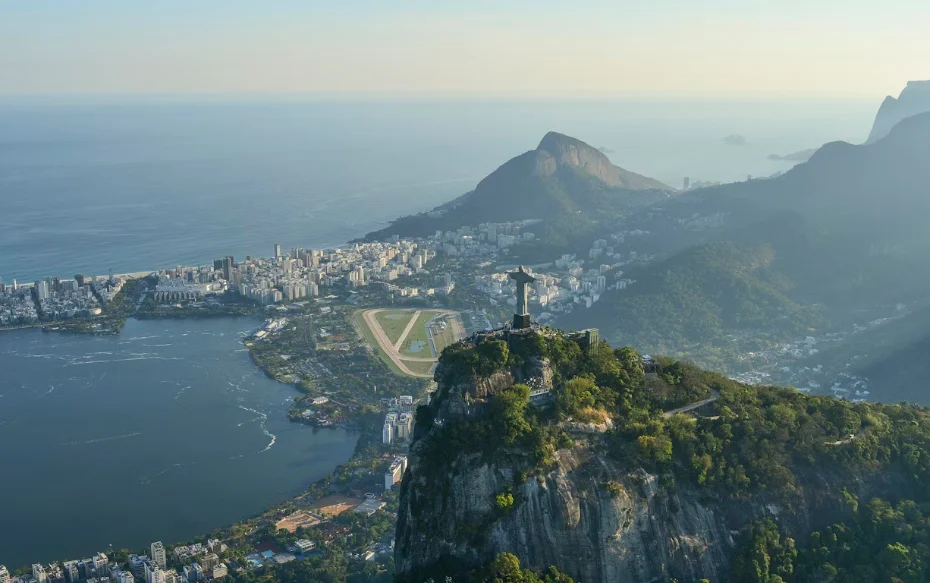
I grew up reading the ocean the way other people read the morning paper. So Rio had been sitting on my list for years, the way a perfect swell sits just offshore — visible, promised, not yet yours. When I finally landed at Galeão, the first thing that hit me wasn't the heat or the noise. It was the light. Rio has this gold, late-afternoon light that makes the whole city look like it's been waxed.
My plan, if you can call it a plan, was loose: a week in Rio living mostly on the beach, then a jump over to Iguaçu for the falls, then home. What I hadn't fully grasped was the scale of this country. Brazil isn't a place you drive across on a whim. It's a continent wearing one flag, and the distances will humble you fast.
Rio, between two beaches
I based myself a few blocks back from Copacabana, close enough to walk down with a towel before the crowds. Mornings were sacred: the long curve of sand, the black-and-white wave pattern on the promenade, vendors already setting up, a few surfers reading the same water I was. Some days I'd walk the whole stretch to Ipanema and back, just to feel the city wake up around me.
The two big ones you've seen on every postcard are worth it, and I say that as someone allergic to box-ticking. Sugarloaf — Pão de Açúcar — you ride up in two cable-car stages, and the second one drops the whole bay at your feet: the beaches, the boats, the green hills folding into the sea. Corcovado, with Christ the Redeemer standing over it all, I did early to dodge the haze. From up there Rio finally makes sense as one shape, the way a coastline only does from height.
« Brazil isn't a country you cross. It's a continent wearing one flag. »
Connectivity-wise, the big cities spoiled me. In Rio, signal was solid almost everywhere I went — beachfront, the top of Sugarloaf, the metro between Copacabana and the centre. That mattered more than I expected, because I was doing everything on the phone: ride apps to get around after dark, a translation app for my very approximate Portuguese, and sending my brother a live video from the cable car because some views you can't keep to yourself. I never had to hunt for a café with Wi-Fi. The eSIM just worked, and I mostly forgot it was there — which is exactly the point.
The jump to Iguaçu
Here's where the scale lesson landed. Iguaçu Falls sit way down in the southwest corner, near the Argentina border, and from Rio that's the better part of a thousand-and-a-half kilometres. People do talk about the bus — it's a long, long overnight haul — but I took the honest option and flew. Couple of hours in the air instead of a full day-plus on the road, and in a country this size, the domestic flight is often just the sane move, not the lazy one.
The falls themselves don't really fit in words, so I won't try too hard. Hundreds of cascades strung across the jungle, the roar you feel in your chest before you see anything, spray drifting up into the trees and catching rainbows. I walked the Brazilian side for the wide panoramic view and spent a long time just standing at the railings near the Garganta do Diabo, soaked and grinning like an idiot. Out there, deeper into the interior, I noticed the signal getting patchier — fine in town, thinner around the park trails. Nothing dramatic, just a reminder that the further you get from the big cities, the more the network thins out, and the smarter it is to download your maps and tickets ahead of time.
Staying easy, staying smart
A word on the street-sense thing, because people always ask. Rio rewards the same calm you'd use in any big city: I kept my phone out of sight when I didn't need it, didn't flash valuables on the beach, took registered rides at night instead of wandering. Nothing fearful — just the basic awareness you'd want anywhere. The city was warm and generous to me; I just met it halfway.
📶 Yann's tip
Get your eSIM installed and ready before you fly out, so it switches on the moment you land — you'll want a ride app working at the airport, not after a hunt for Wi-Fi. In the big cities like Rio the signal is genuinely good; deeper inland, around places like Iguaçu, expect it to thin out, so download your offline maps and tickets in advance. Check your phone's compatibility in 30 seconds here and find your Brazil plan on the destinations page. Heading to Europe next instead? The roam-like-at-home rules already cover you on most European plans, but if you want a dedicated one it's right here.
What I carry home
I came for the waves and stayed for the size of the thing. Brazil taught me to respect distance again — to plan the long hops, to let the beach set the pace and the plane handle the rest. I left with sand still in my bag, a phone full of cable-car videos, and the particular kind of tired you only get from a country too big to finish in one go. I'll be back for the rest of it.
— Yann, salt in his hair, somewhere between the swell and the next departure gate.