
New Zealand: a road trip across both islands
I came to New Zealand to get lost on purpose, and the country obliges within the first hour. You pick up a campervan in Queenstown, you point it at a horizon, and the road does the rest: it climbs, it folds around a lake the colour of melted glaciers, it empties of everything except sheep and the occasional pickup truck. Two islands, a couple of weeks, and a quiet agreement with myself that the plan was to have no plan.
People warn you about the distances and they're right — not because the roads are bad, but because they're slow in the best way. Few motorways, lots of two-lane ribbons hugging coastlines and river valleys. A drive that looks like ninety minutes on a map turns into a half-day because you keep stopping: a waterfall here, a one-pub town there, a paddock so absurdly green it feels staged.
The South Island swallows you whole
Queenstown is the launchpad — adventure capital, all gondolas and jet boats and people throwing themselves off things. I stayed two nights, then fled the buzz for the real prize: the drive to Milford Sound, deep in Fiordland. It is, hands down, one of the great roads on Earth. Mirror lakes, mountain walls dripping with waterfalls, a tunnel bored straight through rock, and then the fiord itself, dark water under cliffs that go straight up into the cloud.
Here's the honest part about staying connected: in Fiordland, you don't. Coverage thins out fast once you leave Te Anau, and around Milford itself I had no usable signal for long stretches — that's normal for one of the most remote, mountainous corners of the country. I'd downloaded the maps the night before and told people not to expect me until I resurfaced. Treat the no-signal as a feature, not a failure.
« Out here the map ends where the asphalt does, and the silence does the rest. »
And the sandflies. Let me warn you the way I wish someone had warned me: Fiordland's sandflies are relentless, especially at dusk near the water. Repellent isn't optional, it's survival gear. I learned this at a lakeside campsite while swatting at my ankles and laughing at my own naivety.
North across the strait
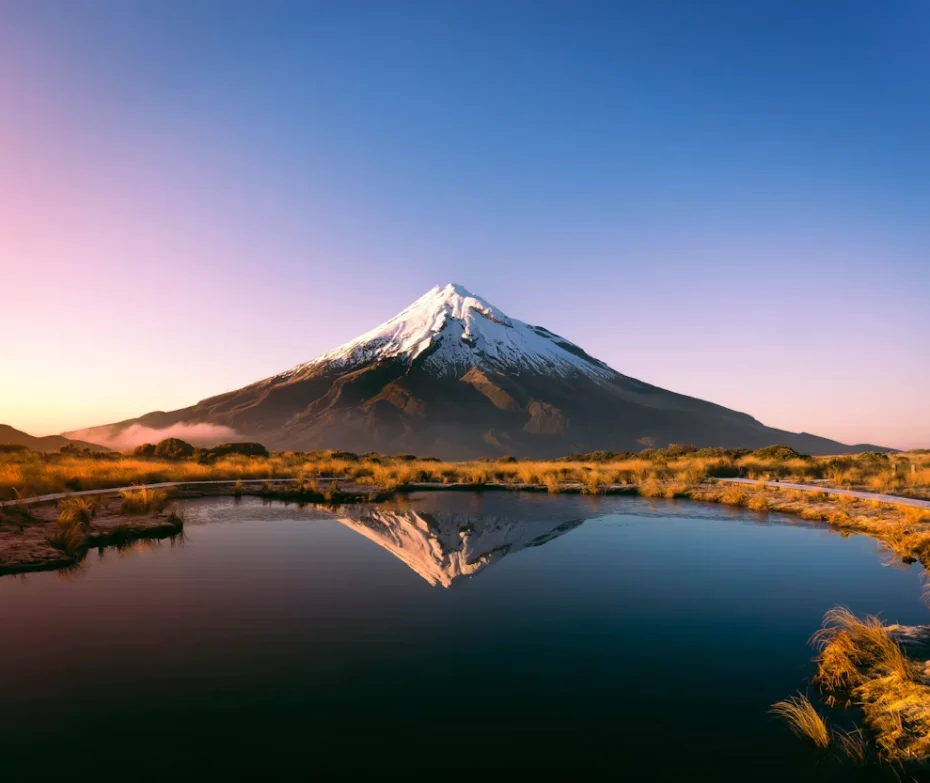
The ferry between the islands is a trip in itself — three-ish hours threading out of the Marlborough Sounds, all green fingers of land reaching into blue water. On the North Island the landscape shifts character entirely: greener, warmer, more volcanic. I steered for Rotorua, where the ground literally steams and the air carries that unmistakable sulphur tang, and then for Tongariro, with its cone-shaped volcanoes standing alone on a high desert plateau.
The Tongariro Alpine Crossing is the famous day hike — emerald lakes, lunar craters, weather that can turn on you without asking. In the towns and at the trailhead car parks I had decent signal, enough to check the alpine forecast (do check it, the mountain is serious) and message my booking. Up on the crossing itself, coverage came and went with the ridgelines — fine for an emergency, not something to rely on. Out here, expect patches of nothing and plan around them.
What the long roads taught me
Two weeks, both islands, more sheep than I could ever count, and a permanent crick in my neck from gawping at scenery. New Zealand is built for the slow traveller: the kind who lets a ninety-minute drive become a day, who treats a dead phone in a fiord as permission to actually look up. I came to get lost. I did. And the lostness was the whole point.
📶 Thomas's tip
New Zealand is outside the EU, so your European roam-like-at-home plan won't follow you here — sort out local data before you fly. Whatever you use, treat the wild bits honestly: coverage is solid in towns and cities, patchy-to-absent in Fiordland and the remote interior, so download offline maps and tell people when to expect radio silence. Check your phone's compatibility in 30 seconds here and browse options on the destinations page. (Planning a European leg on the way out or back? For an EU/EEA destination you can grab a plan on the dedicated EU page instead.)
— Thomas, somewhere on a gravel road with no signal and no complaints.