
Madagascar: the Avenue of the Baobabs, lemurs and the RN7
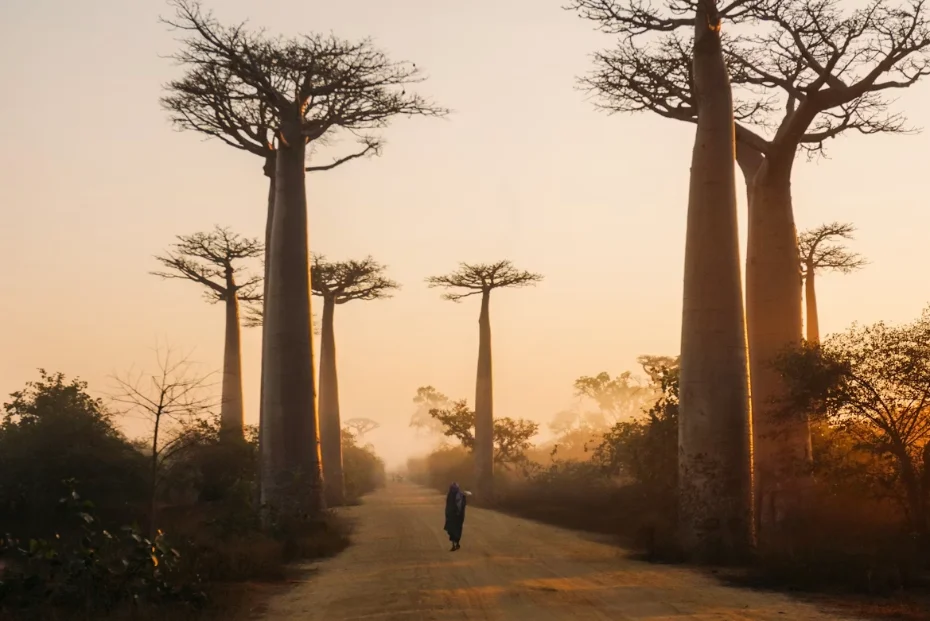
I came to Madagascar for the trees. I'd seen the photo everyone has seen — those impossible bottle-shaped trunks lined up along a dirt track, glowing orange in the low sun — and I told myself that for once I'd build a whole trip around a single image. Spoiler: the trees delivered. But what stayed with me was everything between them — the long red roads, the slow pace, and an island that is, quite literally, like nowhere else on Earth.
You have to make peace with distance here. Madagascar is huge, the roads are slow, and the famous RN7 — the spine that runs south from the capital, Antananarivo — is the kind of road where two hundred kilometres can swallow most of a day. You don't fight that. You lean into it: villages going by, zebu carts, rice paddies, the landscape changing colour every few hours. The journey isn't the boring part. It's most of the trip.
The Avenue of the Baobabs, at golden hour
The Avenue of the Baobabs sits a short drive out of Morondava, on the west coast, and I'd timed everything to be there for sunset. I needn't have worried about whether it would live up to the hype. As the light dropped, the trunks turned copper, the shadows stretched across the track, and the whole place went quiet in that way special spots do when everyone present realises they don't need to talk. These are Grandidier's baobabs, endemic to Madagascar, some of them centuries old. Standing under them, you feel very small and very lucky.
« You don't beat the slow roads here. You let them set the rhythm, and the island does the rest. »
A word on staying connected, because that's the whole point of this blog. In Antananarivo and the bigger towns, mobile data was perfectly usable — enough to message home, check a map, post a baobab photo. Out on the RN7, and especially on the tracks near Morondava, it came and went, and then it simply went. There are real dead zones between towns. I'd treat any coverage outside the cities as a bonus rather than a given, and plan as if, for long stretches, you'll have no signal at all.
Lemurs, and a biodiversity found nowhere else
If the baobabs were the postcard, the lemurs were the surprise that made me grin like a kid. In the parks scattered across the island — Andasibe, a few hours east of the capital, for the haunting call of the indri, the dry forests of the west for the dancing sifakas — I watched animals that exist here and nowhere else on the planet. Madagascar split off so long ago that its wildlife evolved on its own terms: lemurs, chameleons the size of your thumb, baobabs found on no other continent. For someone who travels to get lost in big wild places, this island is almost unfair.
It taught me to slow down in a way I didn't expect. With no signal for hours, I stopped checking my phone and started actually looking — at the forest, at the guides who knew every rustle in the canopy, at a sky with more stars than I've seen anywhere. The connection came back when I reached the next town, and that was exactly when I needed it: to book the next stop, confirm a driver, send the family proof that yes, the trees are real.
📶 Thomas's tip
Madagascar is outside the EU/EEA, so your European roaming won't help you here — sort out your data before you fly. Install your eSIM the evening you land in Antananarivo, while you've still got solid signal, then download an offline map of the RN7 and the Morondava region before heading out: you'll lose coverage for long stretches between towns, and an offline map is what keeps you oriented. Check your phone is compatible in 30 seconds here and find your plan on the destinations page. (If your trip also takes in an EU/EEA leg, you can sort that separately on the Europe page.)
What I take away
Madagascar isn't a place you tick off in a hurry, and it shouldn't be. It rewards the long road, the early starts, the patience to let an island this strange unfold at its own speed. I came for one photograph and left with a head full of orange trunks at dusk, the call of the indri at dawn, and the particular peace of being properly off-grid — with just enough signal, in the towns, to keep the thread with home.
— Thomas, somewhere on a red road, watching for the next baobab.