
The Mekong slow boat down to Luang Prabang
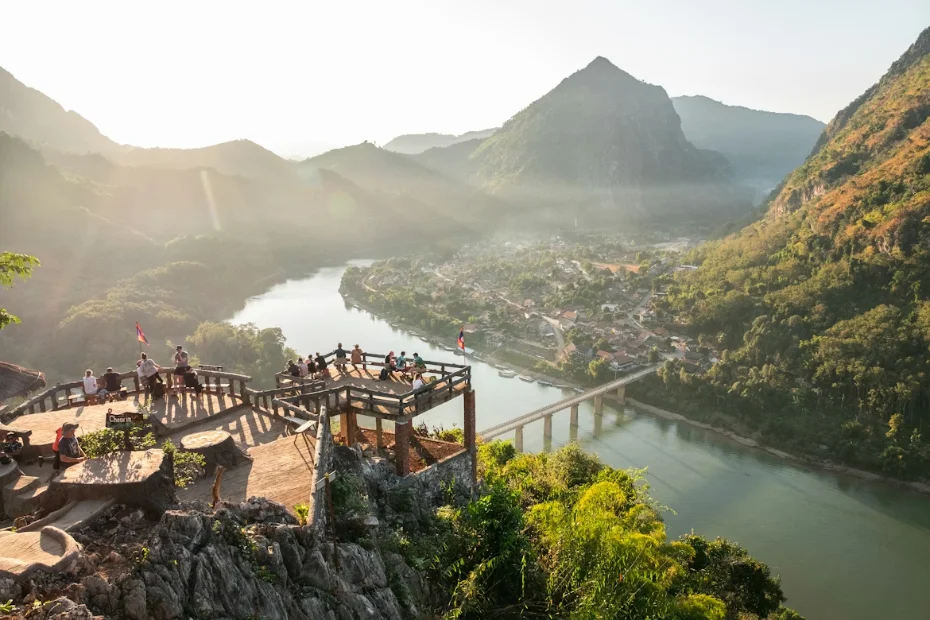
People who know me will not be surprised: after the night trains of Japan and Thailand, I went looking for the slowest boat I could find. I found it on the Mékong, at Houayxay, a dusty little border town where Laos begins. Two days downstream to Luang Prabang, sitting on a long wooden boat with an engine that grumbles like an old uncle. No hurry. That was the whole idea.
The slow boat is exactly what the name promises. You could fly the same distance in under an hour, or grind it out by road. Instead you give the river two full days and let it set the pace. We left mid-morning, the brown water sliding past, and I understood within the first bend that I had signed up for doing absolutely nothing, on purpose, for a very long time.
A river that takes its time
The boat hugs the current between forested hills. Buffalo on the banks, fishermen standing in narrow pirogues, children waving from villages with no road in or out — just the river. Wooden benches, the odd repurposed car seat, a cooler of drinks, and a slow parade of people reading, dozing, watching. I'd brought a book and barely opened it. The window did all the work.
« The river doesn't ask where you're going. It only asks that you go at its speed. »
A word on connectivity, since that's the house specialty — and here I'll be honest. On the river, signal is thin and patchy: a bar or two when you pass close to a village, then long stretches of nothing as the gorges close in. Treat the boat as offline and you won't be disappointed. I'd downloaded an offline map, a couple of podcasts and my onward booking before leaving Houayxay, where the eSIM still had a decent town signal. That's the trick: load up while you can, then let the river have your attention.
The night in Pakbeng
The slow boat breaks the journey halfway, at Pakbeng — a steep little village clinging to the slope, guesthouses lit by single bulbs, the smell of grilled river fish drifting up the lane. Power can be intermittent and data even more so; I'd warned my guesthouse I might go quiet, and I did. We ate by candlelight, swapped stories with the others off the boat, and were back on the water by morning, mist still sitting on the Mékong like a lid.
The second day felt longer and slower than the first, in the best way. By the time the gilded roofs of Luang Prabang appeared around a bend, late in the afternoon, I'd stopped checking the time entirely. Stepping onto the pier, the eSIM found a proper network within a minute or two and I sent the one message that mattered: I made it, I'm here, the river was beautiful.
Temples and the morning alms
Luang Prabang rewards the rhythm the river sets. It's a town of monasteries and slow lanes between the Mékong and the Nam Khan, and its most famous moment happens before dawn: the tak bat, the morning alms-giving, when lines of barefoot monks in saffron move silently through the streets to receive offerings of sticky rice. I went once, early, and put my phone away completely — it's a daily devotion, not a photo opportunity, and the kindest thing a visitor can do is be quiet and keep their distance. In town the signal was steady enough afterwards for a map to the morning market and a video call home over coffee, sticky rice still warm in my hands.
📶 Léa's tip
Set up your eSIM before you reach Houayxay, while you still have a comfortable town signal — and then accept that the two days on the river are essentially offline. Download an offline map, your onward booking and some listening before you board, and warn anyone waiting on you that you'll go quiet between Houayxay and Luang Prabang, with another dark spot overnight in Pakbeng. In town the data is fine again. Check your phone's compatibility in 30 seconds here and find your Laos plan on the destinations page (travelling on to Europe afterwards? An EU/EEA plan is on the destinations page too).
What I take away
We're taught to measure a trip by how fast we cross it. The slow boat argues the opposite for two unhurried days, at the speed of a river that has never once been in a rush. Luang Prabang at the end is the reward, but the lesson is the Mékong itself — and a phone that knows when to be useful in town, and when to simply stay in your bag and let the current do the talking.
— Léa, somewhere downstream, in no particular hurry.